SSBJ and ESRS Compliance

Trend

Providing Individualized Solutions to Companies Seeking to Combine Sustainability and Business Growth From a Starting Point of SSBJ and ESRS Compliance

With increased awareness that responding to climate change and social issues is essential for sustainable corporate growth, there has been a rapid rise in investor and market expectations on corporate sustainability information. In Japan, the SSBJ standards were released in 2025, while in the EU the CSRD went into effect from 2024. How to comply with sustainability disclosure-related regulations is a management challenge that directly connects with how companies disclose information to the capital market and with their future competitiveness.

Each company differs in the characteristics of its business, however, so undifferentiated compliance with regulations that ignores such business or regional characteristics may impose excessive burdens on companies or risk sending the wrong message to investors. It is also essential for companies to drill down to the sustainability-related risks and opportunities they face and focus on the items that are important for them if they are to advance SSBJ and ESRS compliance that contributes effectively to their management. Rethinking strategy and incorporating this into specific business plans and KPIs contributes to the realization of sustainability management.

946740802

Sustainability Evolves From Commitment to Action and Performance Disclosure: In anticipation of SSBJ in 2026 and the extraterritorial application of CSRD in 2028

With the “2050 Carbon Neutrality Declaration” of 2020, companies accelerated their efforts centered on sustainability management, including decarbonization efforts and the implementation of renewable energy. At the same time, the range of themes being tackled by companies in relation to sustainability has diversified and grown in complexity to encompass, for example, addressing geopolitical risks and the construction of supply chains that account for the resource cycle, biodiversity and environmental and human rights. Going forward, companies also need to do more than just declare they will achieve their targets. They also need to set clear milestones and ensure their targets are reflected in their strategies, medium-term business plans and business portfolio transformations in order to reach them.
Ensuring the effectiveness of governance via boards of directors and sustainability committees and promoting responses to global risks through enhanced risk management structures are also important tasks for management at large companies.
So, how should corporate leadership engage in this sort of genuine management agenda while efficiently complying with regulations? We are now in an era where leaders are truly called on to demonstrate clear policy and decision making.

Agenda

Driving Corporate Transformation from a Starting Point of SSBJ and ESRS Compliance

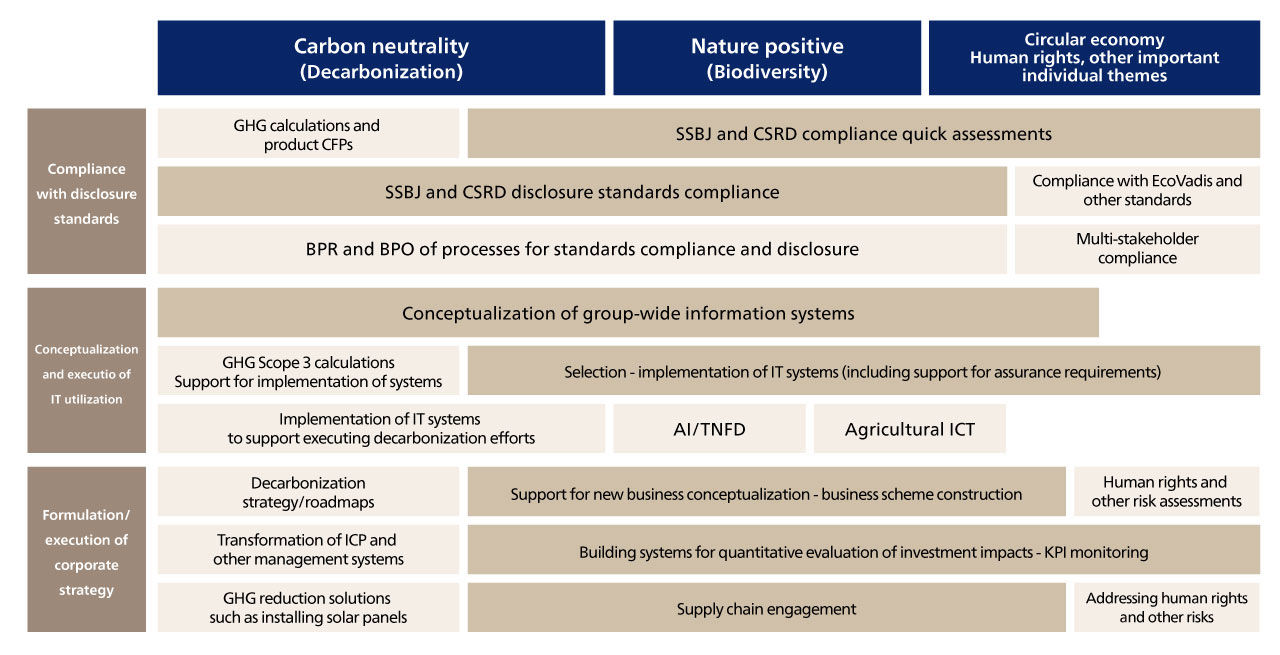
ABeam Consulting provides expert support combining systems and operations to not only ensure readiness and sufficiency for sustainability standards, but also to help companies obtain third-party assurance.

Under SSBJ and ESRS, the disclosure of key information (materiality, compliance strategy, related indicators and targets) related to sustainability-related risks and opportunities is being made mandatory. This necessitates high-level expert knowledge of materiality analysis, risk and opportunity evaluation, Scope 3 GHG emissions calculations and governance and risk management systems. Our highly specialized professional team is ready to help improve the quality and efficiency of your compliance work through side-by-side support in aligning and coordinating across departments and with third-party guarantors as part of real-world operations.

In addition to conceptualizing information systems with a view to acquiring third-party assurance and legally mandated disclosure through securities reports, we support clients in revising operational processes, implementing BPR and selecting and implementing solutions in order to enhance management through the utilization of data.
Leveraging our wealth of management experience in long-term projects, we drive the reliable execution of projects through the visualization of tasks and schedules, proper progress management and the identification of bottlenecks.

Accelerating Sustainability Through Information Systems and Data Management

To drive sustainability, it is important for companies to quickly understand their situations and to be able to flexibly switch between different options while testing the impacts of investments and measures. While even under disclosure systems such as SSBJ and ESRS companies are required to identify and evaluate risks and opportunities across their value chains, for companies active on the global stage in particular, understanding the risks at each of their locations and engaging in management that continually tests and improves on the effects of business promotion policies is essential.
In this context, gathering and analyzing data that contributes to necessary disclosures and management decision making in a timely manner is difficult using traditional systems. This could even result in the stalling out of initiatives such as energy usage optimization, promotion of the resource cycle and water resource management. To reliably execute targeted strategies, it is key for companies to revise their information systems and how they practice data management.

Expanding Sustainability Practices Through Coordination with Suppliers

To reduce GHG emissions, a core theme of efforts to promote sustainability, it is essential for companies to engage not only in efforts to cut emissions internally (Scope 1 and 2), but also to cut emissions across their entire value chains (Scope 3). Improving engagement with suppliers is key to reducing emissions volumes, particularly in the manufacturing and retail industries, where procurement volumes are high and emissions from suppliers (Scope 3, Category 1) are prominent. In addition to offering support in line with the state of programs to reduce GHG emissions at each supplier, it is also important for companies to work closely with their suppliers to build renewable energy procurement schemes and circular economy schemes for the recycling of waste products.
Building positive relationships with suppliers also helps build supply chains that take into account environmental and human rights. Companies thus need to take a holistic view of sustainability management and think in terms of connecting efforts to other sustainability agenda items, rather than simply limiting the contents of each initiative to some single goal.

Approach

Strategy formulation
Implementation of measures

Establish a system for calculating the carbon footprint of products and support the automation of the calculation

Contact

Click here for inquiries and consultations