[India × Japanese Companies] Global Strategies for the Future Driven by Co-Creation and Transformation (Part 1) Why India, and Why Now: New Trends in Global Strategy Seen Through GCCs

Head of ABeam India Business Yasuhisa Omura
News Focus

The speed and magnitude of changes shaking the world—such as increasingly multipolar and complex geopolitical risks—pose significant threats to all economic activities. Under these circumstances, companies are being compelled to respond flexibly and swiftly across borders and to create new value. There is little doubt that the key to breaking through lies in digital technology and the utilization of artificial intelligence.
Amid these global conditions, India is now shining brightly. Until now, India has attracted attention in the information technology domain primarily as a destination for business process outsourcing with strong cost advantages. Today, however, backed by a large pool of highly capable information technology talent, India is shifting toward Global Capability Centers (Global Capability Center, hereinafter referred to as GCCs) that directly contribute to corporate growth strategies, drawing even greater interest.
While some global companies, including major technology firms, are already making bold use of GCCs, how are Japanese companies responding? In July 2025, Yasuhisa Omura, Principal of the Sustainable Supply Chain Management Strategy Unit and Head of ABeam India Business, who led the establishment of ABeam Consulting’s GCC, reveals the latest trends in the Indian market and the strategic utilization of GCCs.

*This article is Part 1 of a three-part series.

Consultant

ABeam Consulting
Principal, Head of ABeam India Business
Sustainable Supply Chain Management Strategy Unit
Yasuhisa Omura

ABeam Consulting Principal, Head of ABeam India Business Sustainable Supply Chain Management Strategy Unit Yasuhisa Omura

GCCs of Global Companies Concentrating in India The Greatest Attraction Is the Depth of the Highly Skilled Information Technology Talent Pool

In July 2025, ABeam Consulting strengthened its existing strategic partnership with BearingPoint (Amsterdam, the Netherlands) and renewed its global consulting service delivery structure. As part of this initiative, in collaboration with its alliance partner, Indian information technology solution company Optimum Solutions, ABeam Consulting independently established Global Capability Centers (Global Capability Center, hereinafter referred to as GCCs) *1.

Approximately 1,800 GCC sites have already been established across India, accounting for the majority of GCCs worldwide. According to estimates by the Japan External Trade Organization, the number is expected to reach 2,550 by 2030, with a market size of USD 110 billion *2. By region, around 30 percent are concentrated in Bangalore, known as the “Silicon Valley of India.” In addition, Hyderabad, where major technology companies such as Microsoft, Amazon, and Google have established GCCs; Pune, which is seeing an increase in research and development centers of Western companies; and Chennai, an academic city where the automotive and information technology industries coexist, are also experiencing remarkable growth in GCCs. The locations selected by ABeam Consulting for its centers are Hyderabad and Chennai, where Optimum Solutions has its bases.

Chennai, located in southeastern India, is home to the Indian Institute of Technology Madras, one of the top institutions among the Indian Institutes of Technology, as well as many universities that produce outstanding information technology talent. These educational institutions possess strong research and development capabilities and are active in international exchange and collaboration with companies, making Chennai an attractive city for global companies focusing on India. Compared with already overheated cities such as Bangalore, Chennai also offers cost advantages, remaining potential for discovering talented individuals, and a stable regional economy with relatively low employee turnover.

India has benefited from long-term political stability under its current administration of more than ten years, and its emphasis on economic measures has borne fruit. The country continues to maintain a high growth rate. At the same time, compared with many developed countries, prices remain stable, and costs directly related to business activities—such as labor and rent—are kept low. Above all, the greatest attraction is its overwhelming working-age population. In particular, India stands out among countries for the abundance of highly capable information technology professionals who speak English.

Against this favorable backdrop, India has developed functions as offshore development centers for information technology companies and as business process outsourcing operations handling call centers and back-office work. Even today, many Japanese companies still associate India primarily with business process outsourcing centers. However, the GCCs now attracting attention cannot be understood in the same context as traditional business process outsourcing.

The clear difference lies in the fact that GCCs handle business-critical functions such as business transformation, engineering, research and development, and digital strategy. This fundamentally differs from business process outsourcing, which focuses on delegating standardized tasks with the primary objectives of cost reduction and operational efficiency by leveraging low labor costs. It is essential to understand that GCCs can serve as “co-creation partners” that drive corporate innovation and digital transformation by harnessing India’s abundant pool of highly skilled information technology talent.

Another reason why global expectations for India’s GCCs are intensifying is their overwhelming strength in the area of “artificial intelligence utilization,” now positioned as one of the most critical management agendas for virtually all companies. Talent that can be described as “artificial intelligence native”—such as individuals who have majored in artificial intelligence at university or have experience working with artificial intelligence at global companies—is the subject of fierce competition worldwide.

As a result, it is difficult for individual companies to secure such talent on their own, and developing it from scratch would take too long. By collaborating with GCCs that already possess such talent, companies can more rapidly implement initiatives leveraging artificial intelligence and build resilience to respond to change, while also creating new value for themselves. An additional advantage is that an environment has been established in which these resources can be utilized remotely, regardless of physical distance.

Yasuhisa Omura

Role Models for Value Creation Through GCCs The Successful Case of Amazon ADCI

How, then, should companies seize these opportunities and utilize GCCs effectively? From here, let us look at specific examples of utilization.
Amazon established its GCC, Amazon Development Center India (ADCI), in Bangalore. This center serves not only as a core hub for Amazon’s software development, artificial intelligence research, and the development and operation of technologies related to Amazon Web Services, but also plays a role in optimizing logistics and supply chains for its e-commerce business.

For example, the generative artificial intelligence–based robot optimization model “DeepFleet,” developed at ADCI, has been deployed on one million robots operating at more than 300 logistics centers worldwide, improving the movement efficiency of robot fleets by 10 percent. In addition, ADCI designs logistics networks that optimize inventory placement and replenishment timing through demand forecasting models that utilize big data and artificial intelligence. Through proposals from ADCI, Amazon’s global operations have been improved, making a significant contribution to faster order processing and shorter delivery times *3.

In conventional business process outsourcing and offshore development, operations were often limited to a “one-way” model of “delivering exactly what the client requested and then concluding the work.” In contrast, GCCs can provide proposals that go beyond requirements, such as identifying areas where the application of artificial intelligence could significantly improve or transform operations. Starting from these proposals, companies refine feasibility and move to implementation. The GCC becomes the operational engine that drives the “value creation cycle” of “creation of transformation themes,” “formulation of transformation concepts,” and “realization of transformation,” as shown on the left side of the figure below. By promoting this seamlessly and through “two-way” communication between headquarters and the GCC, companies can quickly launch strategies directly linked to Chief Officer agendas. This is where the great value of GCCs lies.

Figure 1. ABeam Consulting has built a new global support structure in which Asia and Europe and the Americas work seamlessly together, and the newly established GCC in India plays a major role within this framework.

Even at our GCC, which has only recently been launched, there are already cases worth sharing. In one case involving system maintenance for a manufacturing company, the Chief Information Officer at the headquarters in Japan requested proposals for new maintenance approaches using the latest digital technologies. In response, the GCC monitored the company’s entire maintenance operation, identified issues, and examined the application of technologies including artificial intelligence. Working together with the Japanese headquarters, priorities were set while calculating return on investment, and strategic value creation was achieved through two-way communication.

However, among the management teams of Japanese companies, there are likely concerns about whether communication with Indian resources from a different cultural background can truly meet the high standards demanded by Japan.

Eliminating “Last-One-Mile Issues” The Role of the “Enabler Hub”

Certainly, to make more proactive use of Indian GCC resources, it is desirable for headquarters to define strategies and entrust execution to the Indian side. This approach is well suited to Western companies with strong top-down command structures.
In contrast, Japanese companies have traditionally designed operations in a meticulous, bottom-up manner driven by the front lines, maintaining world-renowned levels of quality.

Even if the Western approach is considered effective, fundamentally changing this culture for the sake of utilizing GCCs is difficult.

These realities were also highlighted by research conducted by our firm. In 2024, we interviewed approximately 50 Japanese companies with operations in India, and what emerged was the issue of the “last one mile.”

This refers to situations in which companies apply their standardized global templates locally, conduct training and education, and even have Japanese staff provide hands-on support for a certain period, yet once full-scale operations begin, gaps arise between the global templates and local operations, preventing them from working smoothly together. To use an analogy, even if shelves in a factory are designated for specific inspected parts, on the shop floor the parts may end up being placed casually on nearby floors or empty shelves. From the Japanese perspective, this is “incorrect,” while locally it may be seen as “acceptable as long as there is no final problem,” leading to differences in perception that can cause stress on both sides.

The conclusion I reached through this research is that forcing Japanese expectations alone will not resolve the issue. Instead, it is necessary to seek hybrid operations that are executable locally through close communication with key individuals who understand both the expectations of Japanese companies and local cultures and ways of thinking.

ABeam Consulting has long valued a support style in which consultants accompanying clients from Japan work together with national members in local markets. Based on the insights gained from this research, we have come to feel that this approach is also effective for the proactive utilization of GCCs by Japanese companies.

To address this challenge, we organized the “Enabler Hub,” a hybrid organization composed of members from Japan and India. At its core are approximately 30 India-related members and Japanese staff on the Japan side, along with members on the India side. This organization integrates “the Japanese way” and “the Indian way,” aligning the quality standards and management approaches sought by Japanese companies with the Indian side. Such a function is unique to the GCC established by ABeam Consulting and, we believe, will greatly contribute to the seamless promotion of business between Japan and India.

Especially in the early stages of GCC utilization by Japanese companies, without a function like the Enabler Hub that bridges differences in culture and sensibilities between Japan and India, the tasks that can be entrusted to the Indian side may be limited to standardized routine work. This would result in underutilization of India’s highly skilled information technology talent and represent a significant loss for companies.

ABeam Consulting has supported numerous management reforms and digital transformations originating from Japan and Asia. In India as well, starting with a capital investment in Optimum Solutions in 2015, we have steadily promoted local business activities. The long-anticipated establishment of a GCC together with Optimum Solutions represents a major step for ABeam Consulting in shifting its consulting services to the next stage.

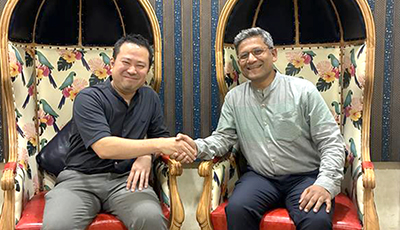
In Part 2, through a dialogue with Mr. Nanda Kishore, a key person at Optimum Solutions who worked together on the establishment of the GCC, we will explore deeper insights into expanding into India.

Notes


Career

Yasuhisa Omura
ABeam Consulting, Principal, Head of ABeam India Business
Sustainable Supply Chain Management Strategy Unit

After joining ABeam Consulting as a new graduate in 2001, he worked on a wide range of projects across multiple industries and regions, primarily focusing on the renewal of global core systems for Japanese companies. From 2016, he spent nine years promoting alliance strategies as the global leader of ABeam Consulting’s SAP business. In 2024, he was appointed leader of the India business launch. Based on on-site research of nearly 40 Japanese companies operating in India, he has developed offerings required for India today. From 2025, he established and began operating a Global Capability Center in India together with Optimum Solutions.

Contact

Click here for inquiries and consultations