

As the Japanese economy returns to a "world with interest rates" and many financial institutions actively move to acquire deposits, the banking business model is now at a historic turning point. Amid these changes, Sumitomo Mitsui Banking Corporation (SMBC), one of Japan’s megabanks, decided to launch an entirely new digital comprehensive financial service for corporate clients, "Trunk."
Trunk is a service that enables and streamlines the digital completion of financial operations essential to corporate management, centered on an online account and business card for Small and Medium Enterprises (SMEs). Trunk also significantly improves the speed and convenience from application to account opening, delivering a financial experience unlike any before.
ABeam Consulting participated from the conceptual stage of this project and provided end-to-end support, including market research, service design, business planning, account opening and operational design, as well as internal change management. For SMBC, this initiative was not merely the development of a new service, but a challenge involving transformation of operations, systems, organization, and mindset.
In this article, Takahiro Yanagisawa, Vice President of the Corporate Digital Planning Office, Wholesale Division at Sumitomo Mitsui Banking Corporation, and Kenta Tanabe, Senior Manager of the Financial Services Industry at ABeam Consulting, who led the support, look back on the background of the Trunk launch and the initiatives that supported its success.
Accompanied from concept to launch of the new corporate financial service "Trunk" ABeam’s business transformation support co-created Sumitomo Mitsui Banking Corporation’s next-generation business model
- Banking/Capital Markets
- DX

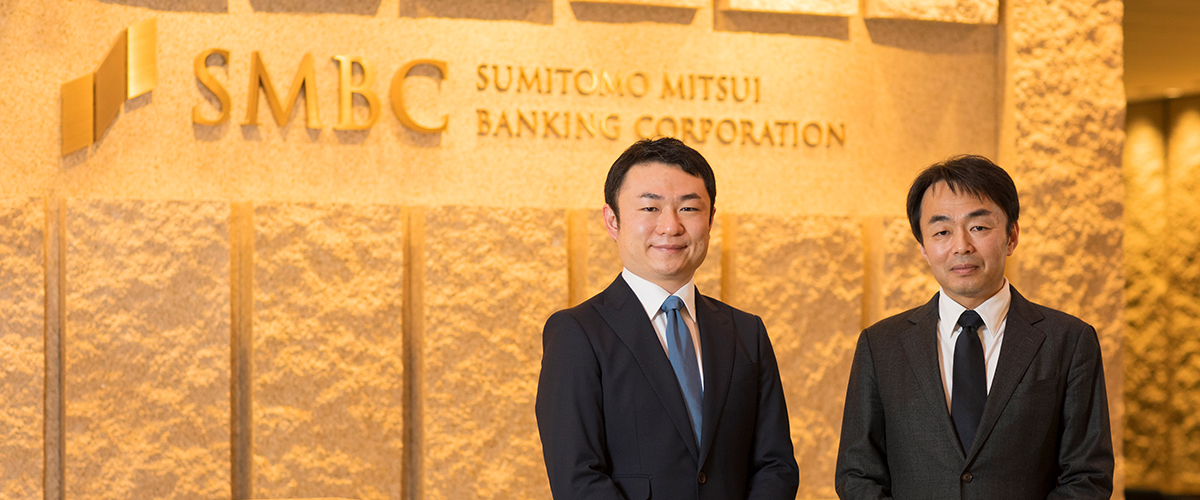 Left: Sumitomo Mitsui Banking Corporation Wholesale Division Corporate Digital Planning Office Vice President Takahiro Yanagisawa
Right: ABeam Consulting Financial Services Industry Senior Manager Kenta Tanabe
Challenge
- With the arrival of a "world with interest rates," deposits have once again become recognized as a source of bank revenue. Although a policy was established to target the SME segment as a new business base, there was insufficient past engagement with SMEs, and knowledge had not been accumulated.
- Additionally, many analog legacy processes remained within the bank, resulting in time-consuming account opening procedures and making it difficult to provide the "fast, affordable, and convenient" financial services that SMEs require.
- To achieve service scalability, it was necessary to transform not only operations but also organizational structures as a digitally completed service.
ABeam Solution
- Leveraged knowledge gained from experience in supporting the financial industry to provide information on precedents and market structures.
- Utilized capabilities and resources to provide end-to-end support from concept to execution, including market research, service design, business planning, and account opening and operational process design.
- As the promotion of the Trunk business represented digital transformation involving operational reform for SMBC, also provided change management support.
Success Factors
- Through customer research and market analysis targeting SMEs, defined a customer-centric service model and quickly clarified the direction of the Trunk business.
- Rapidly digitized previously analog-centered operations, building a service design centered on customer experience, including account opening as soon as the next business day.
- Supported implementation of a new financial service that balances offense and defense by accompanying internal consensus building and change management.
Contents
- 1. Entering a "world with interest rates": Expanding new customer acquisition by targeting SMEs
- 2. Setting "Customer-Centric" as the North Star and transforming operations without exception
- 3. Achieving a balanced service of offense and defense through leapfrogging DX and transformation across the entire business
- 4. The next phase is data-driven decision-making; financial experiences will move closer to the ideal
- 5. Conclusion
1. Entering a "world with interest rates": Expanding new customer acquisition by targeting SMEs
Sumitomo Mitsui Banking Corporation
Wholesale Division
Corporate Digital Planning Office Vice President
Takahiro Yanagisawa

――Please introduce the features of "Trunk" again.
Yanagisawa: Trunk is a "digital comprehensive financial service" for corporate clients centered on corporate accounts and business cards. It is designed to enable the completion of daily fund management operations such as transfers and deposits/withdrawals in a "fast, affordable, and convenient" manner. By using Trunk seamlessly, SME customers can be freed from complex financial operations and focus more on their core business, aiming to deliver such a financial experience.
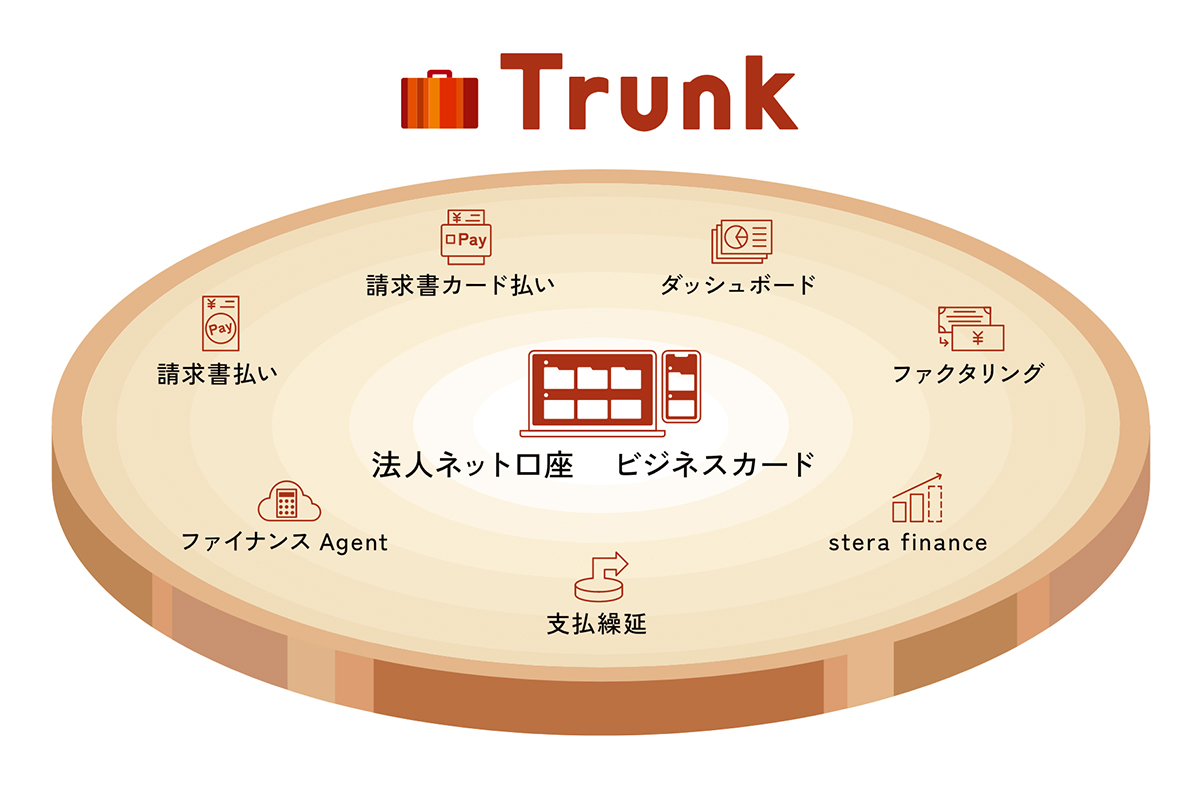 Figure. Trunk Concept Diagram
To achieve this, we thoroughly reviewed existing business processes without exception and rebuilt them from scratch as a "digitally completed" service. As a result, we have realized a customer experience that overturns conventional norms, including "account opening possible as soon as the next business day," "application completed in as little as 20 minutes," "account opening procedures completed via personal computer and smartphone," and "no need for paper documents or seals." In addition, we focused on customer convenience by offering no initial contract fee or monthly usage fee, free transfer fees within the bank, and some of the lowest fees in the industry for transfers to other banks.
In this way, Trunk was launched on May 26, 2025, aiming to provide new value to many customers. As of April 2026, it has surpassed 50,000 accounts and has made a very strong start, and we are continuing to refine the service so that even more users can utilize it.
――Why did you choose SMEs as the main target at this time?
Yanagisawa: The background lies in macroeconomic changes. As you know, the Bank of Japan has shifted from a long-standing negative interest rate policy, and the upward trend in interest rates continues. This has made the "world with interest rates" a reality.
In such an environment, deposits, which had long been viewed as a "cost," have returned to being a "source of revenue" as before the negative interest rate policy, bringing the banking business model to a historic turning point. To respond to these changes, it became necessary to shift to a strategy of actively increasing new accounts to acquire deposits. Within this context, the SME segment, which represents approximately 99.7% of companies in Japan and had not been sufficiently approached by our bank, became a target, with "digital" as the means of delivering value as a key pillar of our new growth strategy.
2. Setting "Customer-Centric" as the North Star and transforming operations without exception
ABeam Consulting
Financial Services Industry
Senior Manager
Kenta Tanabe

――At what stage did ABeam Consulting join the Trunk project?
Tanabe: We participated starting from market research for launching a digital service for SMEs. At that time, although the SME market was assumed to have potential, it was an area SMBC had not sufficiently approached, and there was uncertainty about how far it could be monetized. We conducted market, customer, and competitor analysis to clarify business potential.
Through market research, we identified SME customer needs such as low transfer fees, availability 24 hours a day, 365 days a year via personal computers and smartphones, and simple and speedy account opening procedures. Identifying these clear needs early significantly advanced the project.
Yanagisawa: We met with many SME customers and spoke with them directly. The firsthand voices obtained through interviews, including persona design, were primary information that could never be reached through desk research, and we believed that the "essence" lay in them. Therefore, we prioritized these voices above all and set a policy to advance the project with "customer-centricity" as the North Star. ABeam Consulting joined from this stage of direction consideration.
Of course, that was not the only axis. We considered it necessary to integrate "robust operations based on laws and regulations," which are essential for financial services, "full digitalization" to achieve next-business-day account opening, and "digital transformation (DX)" of the internal operations that support it. We believe that integrating customer-centric thinking, the standards required of financial institutions, and improved convenience through digitalization at a high level was the core of this challenge.
――How did you review account opening operations using digital technologies?
Yanagisawa: Banks have traditionally retained many analog processes such as verification, stamping, and storage based on paper documents. To digitize these all at once, the impact extended beyond individual operations to the entire way of working. In fact, before Trunk, opening a corporate account could take nearly one month due to these overlapping analog processes. With Trunk, we fundamentally reviewed such human-dependent operations and rebuilt them into a new process maximizing digital utilization.
Tanabe: In our consulting experience, we have seen many companies where customer-centricity is advocated but ultimately becomes nominal due to operational constraints. We believe that few companies have been able to build processes that pursue customer-centricity this thoroughly. What do you think enabled this?
Yanagisawa: Together with ABeam Consulting members, including you, Tanabe, we comprehensively examined why the new digital end-to-end process is effective. This gave us confidence that even when replacing traditional account opening operations from "analog" to "digital," we could ensure consistency with regulations, internal controls, and screening standards, and establish a rational basis that internal stakeholders, including front-line staff, could accept. Based on this, we explained with quantitative evidence that the use of digital technology and data would not weaken current control levels but rather enhance them, and gained agreement.
Reactions to digital transformation varied across departments, but all stakeholders shared a sincere desire to serve customers, enabling us to proceed by returning to common top priorities such as customer-centricity.

3. Achieving a balanced service of offense and defense through leapfrogging DX and transformation across the entire business
――What kind of DX support was provided in banks where many analog processes remain?
Tanabe: Typically, corporate digital transformation progresses step by step—digitization, digitalization, then digital transformation—over time. In this project, however, we moved directly from paper-based processes to full digitalization.
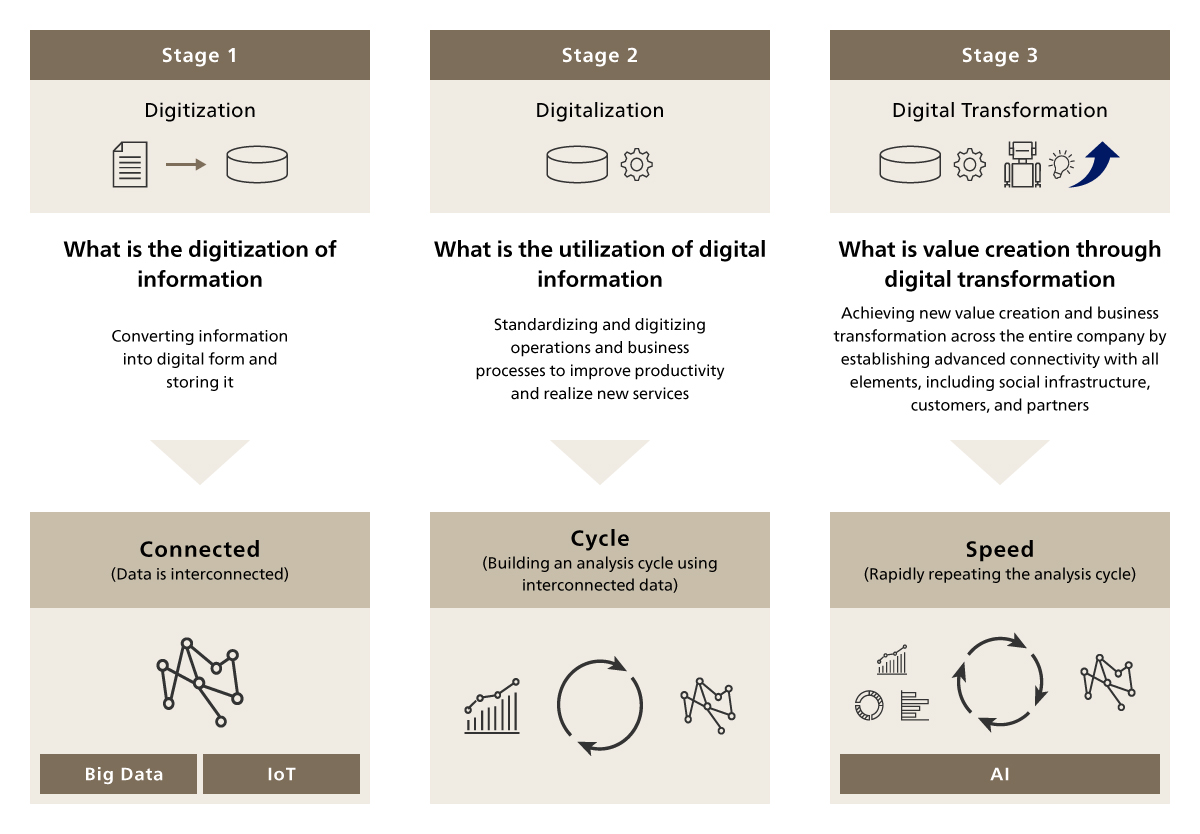 Figure. General Steps of Business Transformation Using Digital Technology
Given SMBC’s large organizational scale and the fact that the account opening reform in Trunk involved transformation across all three components of business—operations, systems, and organization—the difficulty level was extremely high.
Yanagisawa: As mentioned earlier, SMBC focused on thoroughly digitizing the account opening process. We replaced and automated the entire operation, which had been largely analog, with digital processes. Because of the large organization and scope of analog processes, the impact of efficiency improvements through digitalization was immeasurable. In addition to improving operational efficiency and reducing errors internally, digitization also contributed to improving customer experience.
A representative example is the fundamental redesign of the account opening input form. Previously, approximately 200 input fields were required for account opening. We reviewed this from a customer perspective from scratch, incorporating mechanisms such as integration with external services and automatic reflection of information obtained through identity verification.
As a result, the number of input fields was reduced from approximately 200 to around 70. Furthermore, by involving designers and discussing usability down to the finest details, we developed a form and user flow that enables intuitive input with minimal confusion. Here as well, we prioritized customer-centricity and improved quality through an agile approach, repeatedly incorporating feedback directly from SME customers.
Trunk was also designed to allow input not only from personal computers but also from smartphones, considering the busy scenarios of SME customers. Additionally, we incorporated the latest technologies, introducing identity verification using the Individual Number Card (JPKI authentication) for the first time in Japan for corporate account opening.
Through these initiatives, we significantly reduced the time required for account opening applications to approximately 20 minutes, delivering a comfortable experience. Ultimately, we believe we created a service that highly integrates "offense" represented by outstanding user experience and "defense" represented by safety and security.
Tanabe: On the "defense" side, we reviewed all applicable laws and regulations for account opening, including the Act on Prevention of Transfer of Criminal Proceeds, and examined from scratch how to apply digital technologies. As a result, we believe we achieved a level of control equal to or greater than before through digitization.
――We understand that not only customer-facing aspects but also operational processes invisible to customers were reformed.
Yanagisawa: The high hurdle of achieving "corporate account opening as soon as the next business day" cannot be overcome by user experience improvements alone. We also fundamentally reviewed processes through digitalization in parallel. Key initiatives included eliminating paper-based screening, building systems to support screening, and automating confirmation items.
These efforts enabled the first-ever corporate account opening at a megabank as soon as the next business day.
Tanabe: While progressing with the drastic transformation toward the Trunk release, fostering mindset change and change management for accepting transformation was also an important support theme. Transitioning long-standing analog-based operations to digital processes is a discontinuous change that requires significant shifts in awareness and behavior among those involved. To achieve this, process design alone is insufficient. Leveraging our expertise and track record in change management, we provided both tangible support such as process management and initiatives to align stakeholders’ awareness and mindset, considering how to enable smooth transformation.
This case represents not only the creation of an innovative financial service but also an advanced example that vividly illustrates the essence and potential of corporate digital transformation.

4. The next phase is data-driven decision-making; financial experiences will move closer to the ideal
――Looking back, please explain the role of ABeam Consulting in this project.
Yanagisawa: The vision we aimed for with Trunk was to maximize results through "capability (digital)" rather than "manpower." There are limits to continuing analog-based approaches for the many SME customers we serve. Therefore, it was necessary to thoroughly review human-dependent operations and enhance efficiency and scalability through digital technology.
However, given the countless challenges, we did not know where to start and needed to quickly find a reliable partner. ABeam Consulting, with its knowledge of the financial industry and abundant resources with the necessary capabilities, was selected to support us.
From providing information on precedents and market structures, to analytical capabilities that derived insights from market research including collaborative interviews, to business planning and project management and execution based on that plan, we are grateful that their end-to-end and timely support enabled us to reach this point.
Above all, we are particularly grateful for ABeam Consulting’s business concept development capabilities. This project was not an extension of conventional financial institutions but required truly creating something from zero.
Our bank lacked sufficient knowledge and experience in the SME segment, and the project team at launch was very small, including myself. To be frank, there was more uncertainty than confidence about how to advance such a difficult project.
In this context, ABeam Consulting demonstrated the ability to concretize new business concepts and move forward even in a highly specialized domain like finance, starting from a near blank slate. They organized and classified what initially appeared to be countless issues, structured them chronologically, and clearly indicated what and how to solve. Through this project, we were able to establish not just knowledge but practical know-how for advancing large-scale projects.
Tanabe: Financial services like this, which capture the needs of a digital-native future, represent business models that can provide sustainable value. We are proud to have been involved from the conceptual stage in such a forward-looking project, and we believe that among Trunk users, there may emerge high-growth companies that will drive the Japanese economy, which makes this initiative highly meaningful from a social value perspective as well.
――Based on the journey so far, what future potential do you see?
Tanabe: Now that support up to the release has been completed, the focus has shifted to the post-release stable operation phase. Key support areas include establishing a post-release plan–do–check–act cycle, revising business plans, further enhancing account opening and screening processes to achieve targets, and defining mid- to long-term initiatives. Additionally, digitization has opened up various possibilities, and we see opportunities to propose further service enhancements.
Yanagisawa: I agree. Until now, the focus was on digitizing operations and achieving efficiency and speed. However, the value created by this digital transformation goes beyond that. One major outcome is the ability to accumulate customer information and utilize it as a database. We expect this to have significant implications for SMBC’s future.
Previously, customer information tended to remain fragmented and limited due to reliance on analog and face-to-face interactions. Going forward, this will transform into a valuable asset. This will enable new proposals and services based on customer usage, as well as the planning of various initiatives. By making this accessible to relevant employees, we will be able to conduct more advanced and agile validation of customer measures and hypotheses. This represents the realization of "data democratization." Looking further ahead, we also see the potential for artificial intelligence utilization to significantly enhance customer value.
――How do you plan to further enhance value for customers through Trunk going forward?
Yanagisawa: Trunk has already surpassed 50,000 accounts and is being used by a large number of customers. What we have reconfirmed is the great potential of digitally enabled services. While there were previously physical constraints such as branch networks and manpower, digital technology is making it possible to deliver value beyond these barriers.
In fact, Trunk users are already spread across all 47 prefectures in Japan, and it is used by a wide range of customers regardless of age or gender. We have received positive feedback from customers, and we feel that our consistent focus on customer-centricity is beginning to translate into value. Each time we encounter such responses, we strongly feel that our efforts to date are yielding tangible results.
The SME segment we serve accounts for 99.7% of Japanese companies. Supporting their daily operations through financial services and enabling them to focus more on their core business and growth has great significance for Japan’s economic resurgence. Starting with Trunk, we will continue to challenge ourselves to evolve the value we provide and unlock new financial experiences.
5. Conclusion
This project represents one of the leading transformation cases in Japan, where a traditional megabank advocated customer-centricity, redefined its organization and operational processes, and created entirely new value through full utilization of digital technology. ABeam Consulting partnered closely with the client from concept to implementation and adoption in this project, which significantly transformed a long-standing business model. Going forward, beyond operational improvements, ABeam Consulting will continue to support transformation as a partner that co-creates the future of finance by innovating business models themselves.
Customer Profile
- Company name
- Sumitomo Mitsui Banking Corporation
- HQ Location
- 1-1-2 Marunouchi, Chiyoda-ku, Tokyo
- Estd.
- 2001
- Business
- Banking operations
- Capital stock
- 1,771 billion yen
Jul 21, 2026
* Company names, titles, and positions are current as of March 2026.
Click here for inquiries and consultations