

The BHCA Compliance Planning Office of the Credit Policy & Planning Division at Mitsubishi UFJ Financial Group (MUFG) (hereinafter, the "user department") undertook an initiative to enhance the operational platform that centrally manages information on tens of thousands of investees, supports compliance checks against regulations related to the U.S. Bank Holding Company Act, and facilitates annual reporting to the Federal Reserve Board. As a partner with extensive knowledge of the operations, ABeam Consulting began supporting the project in April 2024. Using the low-code development platform "OutSystems" and ABeam's proprietary framework "ABeam OSF" (OutSystems Framework), ABeam Consulting supported rapid prototype development and iterative implementation. A new system for Bank Holding Company Act compliance operations, integrating registration, calculation, and output, was built in approximately one year. After the system was released, ABeam Consulting continued to provide hands-on support for one year, contributing to the user department's ongoing improvements and promotion of in-house development.
Building a New System on OutSystems for U.S. Bank Holding Company Act Compliance and Enabling the User Department to Operate and Maintain It In-House
- Banking/Capital Markets

Challenge
- The need for a lean team of just over ten people to centrally manage up-to-date information on tens of thousands of investees
- Transition from operations involving manual work and visual checks to a robust, reproducible, and highly reliable operational platform
- Establishment of a user department-led continuous improvement model capable of responding quickly to regulatory changes and changes in business requirements
ABeam Solution
- Built a robust new system comprising a web application and a relational database by leveraging OutSystems and a proprietary framework
- Achieved production launch in approximately one year through Enterprise Agile (agile development for large organizations), incorporating the expertise of the user department with extensive knowledge of the operations
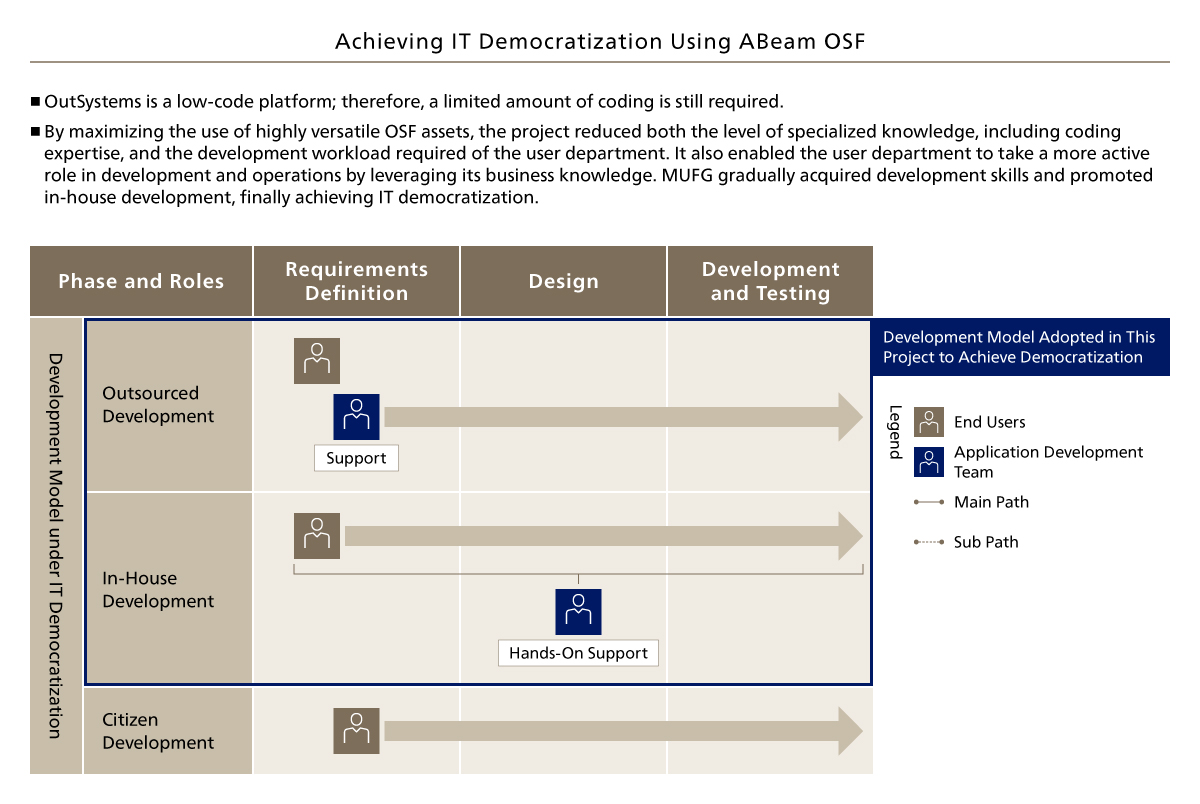
- Established a self-sustaining operating model through phased technology transfer, enabled by joint development with the user department and hands-on support after the system went live
Success Factors
- Reduced the development period for the new system by 50% through the use of OutSystems and ABeam OSF
- Reduced the time required to calculate the percentage of voting rights held by the MUFG Group in investees from several hours to approximately 10 minutes (a 90% reduction)
- Improved operational efficiency by up to 30% while continuously advancing the user department's skill development and in-house operation and maintenance capabilities.
Client Challenges
Introducing a Platform That Both Meets Advanced Business Requirements and Enables the User Department to Operate Independently
The user department consolidates information on numerous investees and is responsible for providing various forms of advice to departments overseeing investments regarding rules related to the U.S. Bank Holding Company Act, preparing annual reports for the Federal Reserve Board, and handling attestations related to compliance with the Volcker Rule. From a regulatory compliance perspective, these operations require a high degree of accuracy and stable business continuity. The existing operational platform supporting these activities was rapidly developed in accordance with the business requirements at the time and had been used as the foundation supporting business operations. Subsequently, as the operations expanded and became more sophisticated, the platform reached a stage at which it needed to evolve into an operational foundation that could comprehensively reduce manual work through automation, improve system stability, visualize processing, and flexibly accommodate future changes in operations.
The central issue in this project was achieving both "self-sufficiency (in-house development)" and "enhanced functionality." No-code and low-code tools generally available within MUFG offer the advantage of enabling the user department to begin development relatively easily, but they also have certain limitations when implementing the advanced and complex requirements demanded by regulatory compliance operations. Conversely, custom development from scratch by professional developers can more readily address advanced requirements, but it makes it difficult for a user department without coding expertise to assume responsibility for upkeep and maintenance. A platform and approach were required that could simultaneously satisfy the requirement to "deliver advanced functionality through low-code development while enabling the user department to maintain and manage the system independently."
ABeam Consulting had continuously supported the development and maintenance of the existing end-user computing tools and the preliminary study phase. As a partner with extensive knowledge of the business, systems, and data flows, ABeam Consulting contributed to introducing a platform that both addressed advanced business requirements and enabled the user department to operate independently.
Key Project Success Factors
Enterprise Agile that incorporates the expertise of the user department, which has extensive knowledge of the operations, and hands-on support for establishing a self-sustaining operating model
The most significant factors supporting the success of this project were development steps designed with technology transfer for in-house development in mind and agile project management that incorporated the needs of the user department.
Drawing on its existing support expertise, ABeam Consulting organized the issues in advance and proceeded with development while confirming priorities with the user department. For the coordination of issues at the specification level, however, ABeam Consulting avoided the misunderstandings that tend to occur in specification-based reviews by repeatedly holding sessions in which working screens (prototypes) were reviewed in demonstration format and by providing the user department with direct access to the OutSystems development environment so that its members could interact with the system at their own pace and increase their proficiency.
A phased methodology based on Enterprise Agile was adopted as the development approach. Development lots were organized progressively from the main scenarios to derivative scenarios, with repeated cycles of development, testing, and user confirmation. A cloud-based project management tool was used for issue management, and the project was managed around weekly progress meetings and biweekly owner reporting meetings while progress was visualized and shared online.
During the latter half of development, with a view to technology transfer ahead of post-launch operations, the user department participated in developing relatively simple screens and functions, using components developed in advance by ABeam Consulting, and performed hands-on work with support from ABeam Consulting. By participating in actual development and reviewing the considerations and deliverables from each phase together with ABeam Consulting, the user department deepened its understanding of system development and progressively accumulated the necessary knowledge and experience. ABeam Consulting's hands-on support for these practical activities from both technical and quality perspectives has helped develop personnel capable of independent operations and establish a foundation for continuous improvement.
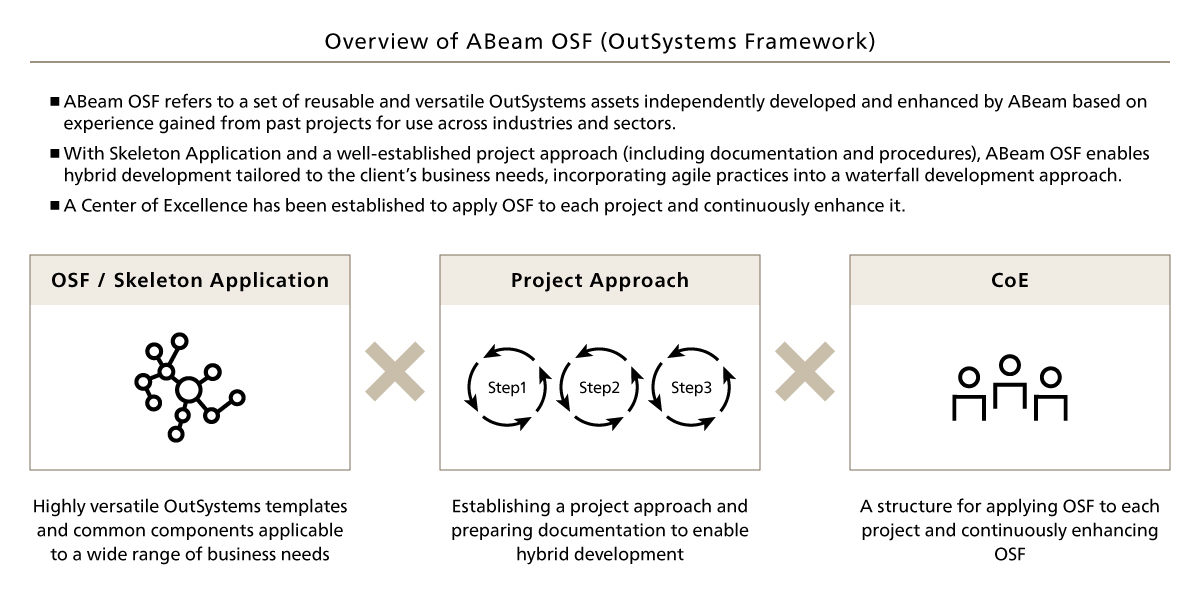
ABeam’s Contribution
Rapid Development and In-House Development Support Enabled by Business Understanding and a Proprietary Framework
ABeam Consulting's contribution to this project can be summarized in three areas: improving development productivity through the use of OutSystems and a proprietary framework, facilitating smooth project execution based on a deep understanding of the user department's operations, and providing hands-on technical and personnel support with independent operations in mind.
ABeam Consulting's proprietary ABeam OSF (OutSystems Framework), equipped with highly versatile skeleton applications and design document templates, enabled Enterprise Agile development in which iterative implementation could proceed in stages immediately after the project began. Using OutSystems, which is recognized as a low-code tool, as the development platform, the project improved development efficiency through the use of common components and templates while promoting standardization and consistency. In addition, with hands-on support from ABeam Consulting, the project helped establish a structure in which the user department could take responsibility for developing certain functions. As a result, screens and functions reflecting the business logic were built over an approximately 10-month development and testing period.
The new system created through these efforts was released in March 2025 and is contributing to stable business continuity, improved productivity, and stronger security and data governance. Even after the system became operational, the user department participated in actual development and deepened its understanding of system development by reviewing the considerations and deliverables from each phase together with ABeam Consulting. ABeam Consulting continued to provide hands-on support from both technical and quality perspectives and also assisted in creating a skills map that enables the identification and assessment of the skills required for system upkeep and maintenance. These initiatives have helped develop personnel capable of independent operations and establish a foundation for continuous improvement. Building the capability to respond flexibly to changing financial regulations and business needs provides important value not only in terms of cost, but also in enhancing regulatory compliance and improving operational quality.
Building on the insights gained from this project, ABeam Consulting will support the BHCA Compliance Planning Office of the Credit Policy & Planning Division in examining further enhancement of its operations, and will also propose the potential application of OutSystems-based operational improvements to other departments facing similar challenges.
This project was an initiative to redesign the operational foundation for U.S. financial regulatory compliance- one of the critical functions supporting the MUFG Group's global regulatory compliance—rather than simply systematizing the existing operations, with the aim of enabling stable operations well into the future. The introduction of the new platform enabled us to standardize and visualize processes from data import and calculation through report output, thereby improving operational quality and continuity. ABeam Consulting accurately understood the characteristics of our department's operations and the requirements of regulatory compliance and supported us from concept development through migration in a manner aligned with actual operations. We highly value the establishment of a sustainable platform that supports more sophisticated regulatory compliance.
Credit Policy & Planning Division
BHCA Compliance Planning Office
Managing Director
Teruyoshi Yamamoto
A key theme of this renewal was achieving both the quality and functionality required to meet financial regulatory requirements and the flexibility for the user department to identify its own needs and make modifications. By using OutSystems and ABeam OSF and proceeding with development and confirmation in stages based on the Enterprise Agile concept, we were able to release the system on schedule while reflecting our needs. In particular, demonstrations using working screens and iterative reviews were effective in aligning our understanding of business requirements that are difficult to capture from specifications alone. We believe that ABeam Consulting's business and technical expertise enabled us to implement a practical platform with robustness, security, and maintainability.
Credit Policy & Planning Division
BHCA Compliance Planning Office
Vice President
Katsuma Morikawa
A system is not complete when it is released. It is important to establish an operating model that can maintain stable business operations while responding to changes in regulations and the environment. To this end, through ABeam Consulting's training support using a skills map and through pair programming, we have developed our own capabilities to assume responsibility for maintenance and operations. Approximately one year after the release, we are now establishing a self-sustaining operating model that continuously improves data quality and manages data under appropriate controls. I feel that the platform is evolving beyond simple in-house development into an operational foundation that can maintain and improve the reliability of operations and data while responding to change.
Credit Policy & Planning Division
BHCA Compliance Planning Office
Vice President
Reika Tanaka
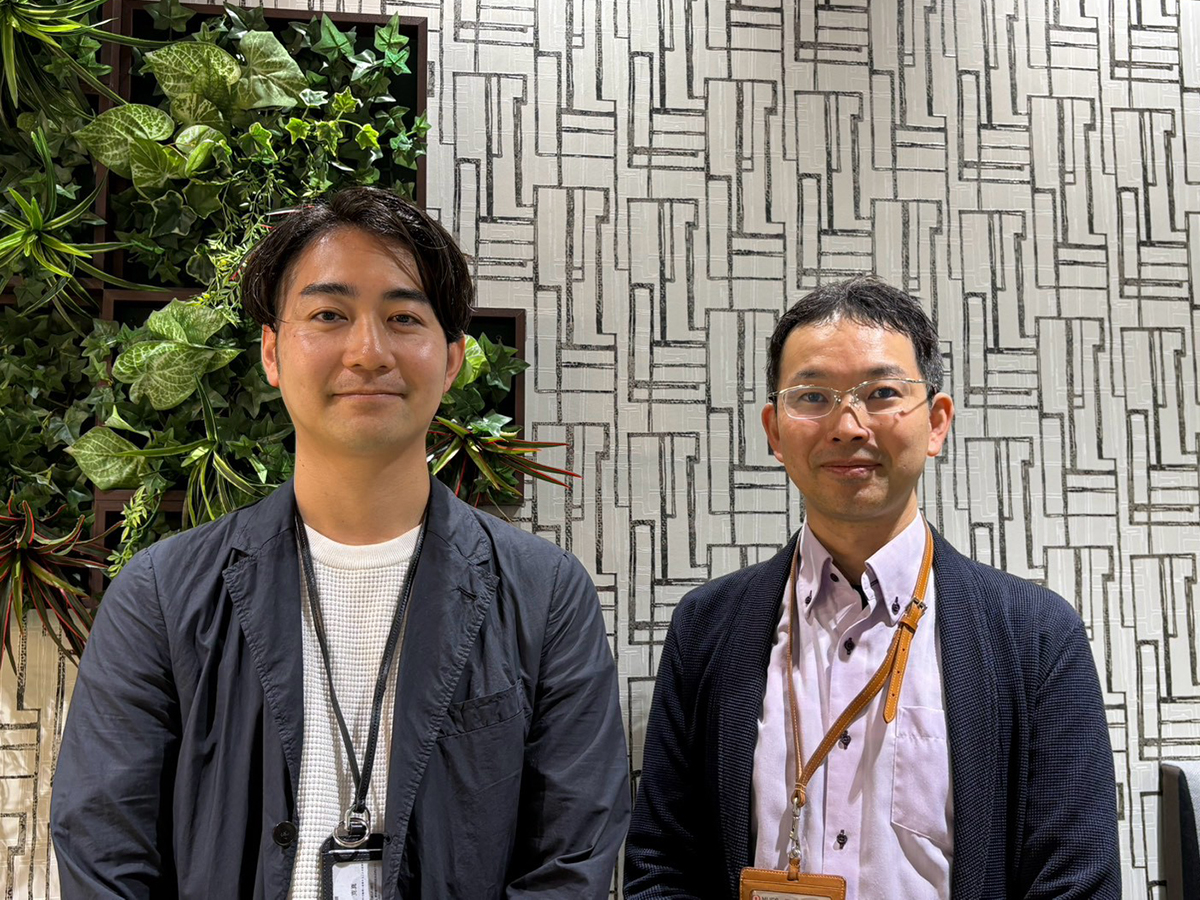
Right: Credit Policy & Planning Division BHCA Compliance Planning Office Managing Director Teruyoshi Yamamoto
Customer Profile
- Company name
- Mitsubishi UFJ Financial Group, Inc.
- HQ Location
- 4-5, Marunouchi 1-chome, Chiyoda-ku, Tokyo
- Estd.
- April 2, 2001
- Business
- Management of subsidiaries and the Group, and operations incidental thereto
- Capital stock
- JPY 2.1415 trillion (as of March 31, 2026)
Nov 17, 2026
-

Koji Ogawa
Principal
Click here for inquiries and consultations