

Tokyo Tatemono Co., Ltd. (hereinafter referred to as Tokyo Tatemono) has articulated a long-term vision looking ahead to 2030, titled "Becoming a Next-Generation Developer" and aims to achieve both the "leveraging its businesses to solve social issues" and "higher levels of growth as a company". While maintaining stable rental income as its foundation, the company is promoting the realization of a well-balanced profit structure with an emphasis on capital efficiency.
While continuing stable growth, the increase in the number of properties has made the efficiency of mid- to long-term planning operations a key challenge. Furthermore, in order to achieve corporate growth at a higher level, the advancement of business operations had become an urgent issue.
To address these challenges, ABeam Consulting, which has a track record of implementing ACRES (real estate management solutions) for the company, began providing support in September 2022. Within one year, ABeam Consulting realized everything from the formulation of the overall project concept and the organization of business issues to system implementation and quickly established the foundation for "Evolution of management Infratructure to support growth" which is a basic policy of the medium-term business plan. Subsequently, ABeam Consulting has continued to provide hands-on support to this day to ensure system adoption, periodically expand and review the concept in line with changes in management needs, and steadily achieve milestones, thereby realizing repeated improvements in operational efficiency and sophistication.
DX Support for Business Process Transformation in Mid- to Long-Term Planning and for Enhancing Management Infrastructure to Drive Growth
- Real Estate/Construction/Housing
- DX
- Financial Accounting and Business Management

Challenge
- Advancement of property sale strategies and financial strategy development toward achieving mid- to long-term plans
- Implementation of simulations to prepare for the risks of rising construction costs and economic downturns
- Reducing the aggregation workload of corporate and business planning departments responsible for mid- to long-term planning
ABeam Solution
- Development of an overall project plan with a focus on risk mitigation and early value realization, along with proactive execution involving key stakeholders
- Visualization of operations and identification of issues through cross-functional interviews conducted by members with expertise in developer and planning functions
- End-to-end support from concept development through implementation, delivered by members with a strong understanding of solution characteristics
Success Factors
- Enhancing the accuracy of business planning and strengthening the robustness of financial planning through centralized management using Anaplan
- Enabling company-wide visibility of financial metrics and scenario simulations in the event of risks such as rising construction costs and rent declines due to economic downturns
- Driving faster executive decision-making by accelerating mid- to long-term planning
Client Challenges
Improving the efficiency and sophistication of mid- to long-term planning by aligning business and financial plans
The Corporate Planning Department prepared, once a year, the company-wide mid- to long-term plans for the balance sheet (BS), profit and loss statement (PL) and cash flow statement (CF) entirely in Excel, aggregating property-specific mid- to long-term business plans submitted by each business division, as well as financial plans including financing and repayment schedules.
The department faced limitations in flexibly modifying plans while ensuring alignment between business plans and financial plans, such as considering property sale timing in a more strategic and timely manner, reviewing financing plans in response to adjustments in sale timing, and managing and examining multiple plan scenarios in Excel.
In addition, as the business plans for an increasing number of properties were exchanged in Excel from individual property managers to the business planning departments of each business division and then to the Corporate Planning Department, aggregation of company-wide figures required significant time, making it difficult to provide timely reports to management.
As a result of the substantial time devoted to aggregation work, the department was unable to allocate sufficient time to analyses that the planning function should originally undertake, such as examining the business portfolio and conducting simulations toward achieving mid- to long-term plans, as well as analyzing the impact of risks such as rising construction costs and economic downturns on company-wide figures.
To improve this situation, ABeam Consulting was selected as a partner for business process reform aimed at improving the efficiency of mid- to long-term planning operations and advancing operations that had previously not been achievable.
Key Project Success Factors
Adoption of a phased, small-start expansion approach to reduce risk and deliver early value
The transformation of mid- to long-term planning operations began with the visualization of processes within each business unit and the identification of bottlenecks, followed by the decision to implement Anaplan, an Enterprise Performance Management (EPM) solution. While it is important to define an ideal future-state vision in system implementation, attempting to realize all functionalities at once can lead to rework and delays in achieving benefits. To mitigate risks and realize value early, a small-start approach was adopted, initially limiting the scope of target operations and gradually expanding it in phases. In addition, by flexibly incorporating requirements that emerge during actual operations, the scope of DX initiatives has been continuously expanded, driving ongoing improvements in both efficiency and sophistication of business processes.
STEP1: Establishment of a mid- to long-term planning platform integrating business and financial plans
A mid- to long-term planning platform was established which can be registered property-specific mid- to long-term business plans created in Excel, along with financial financing and repayment schedules, into Anaplan, enabling reference to company-wide BSs, PL, CF and key performance indicators (KPIs) with alignment between business plans and financial plans. Previously, even aggregation alone required a significant amount of time and conducting simulations was an even more burdensome task; however, after the platform was established, the situation changed to one in which rapid aggregation and flexible simulations became possible. In addition, mid- to long-term plan updates, which had previously been limited to once a year, could now be immediately reflected in the company-wide plan whenever a property business plan was changed. Automatic aggregation by the system significantly reduced the workload of the planning departments and enabled timely reporting to management. As a result, it became possible to allocate more time to simulations and strategic considerations.
STEP2: Risk Simulation for Rising Construction Costs and Economic Downturns
Following the establishment of the mid- to long-term planning platform, the next initiative focused on enhancing preparedness for risk events. A mechanism was implemented that enables the Corporate Planning Department to instantly assess the impact on company-wide BS, PL and CF by simply inputting parameters when risks—such as rising construction costs, declines in sales prices due to economic downturns, or decreases in rental income—materialize in property-level business plans.
STEP3: Improving the Planning Accuracy of Newly Acquired Prospective Properties
As the real estate business is a mid- to long-term business, it is important to conduct studies that take into account how large a scale of land will be acquired in the future, what kind of development will be undertaken, when completion will occur, and how these factors will impact the company-wide business plans and financial plans. Although business plans for newly acquired prospective properties had been developed in the past, the centralized system management of existing property information enabled the creation of more accurate plans for newly acquired prospective properties by leveraging data analysis of business plan data for existing properties.
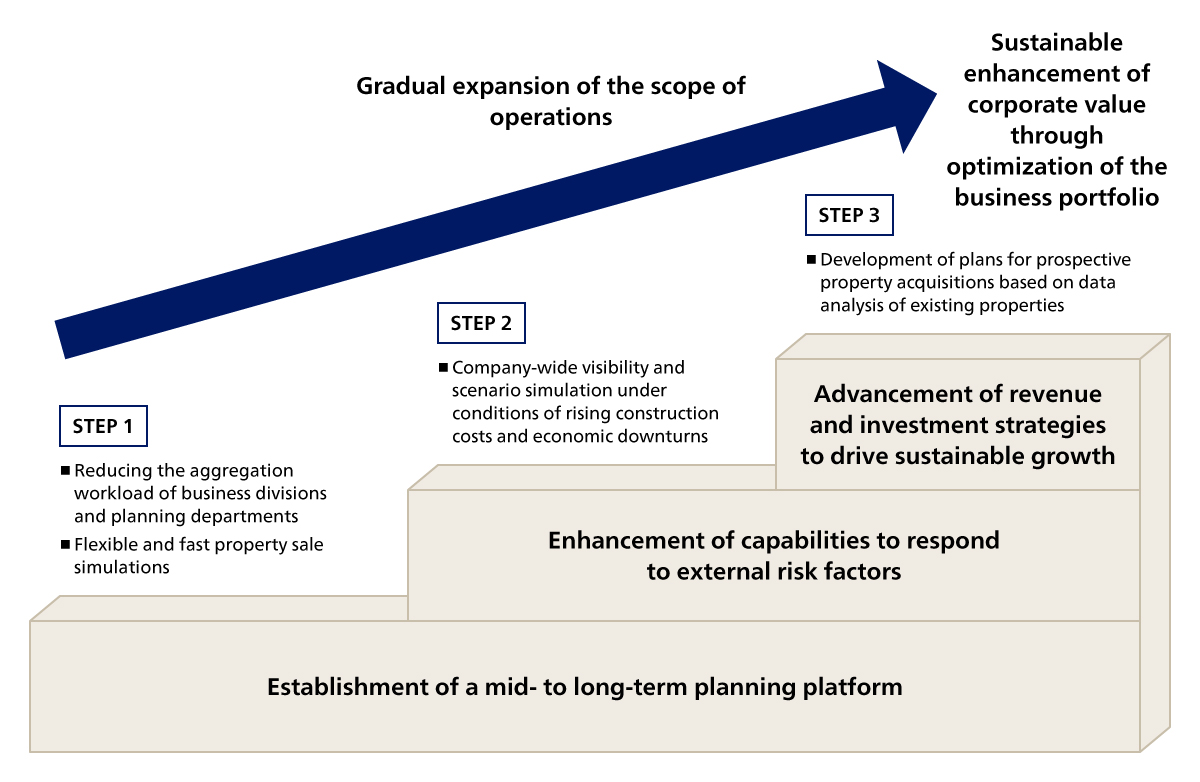 Gradual expansion of the scope of operations
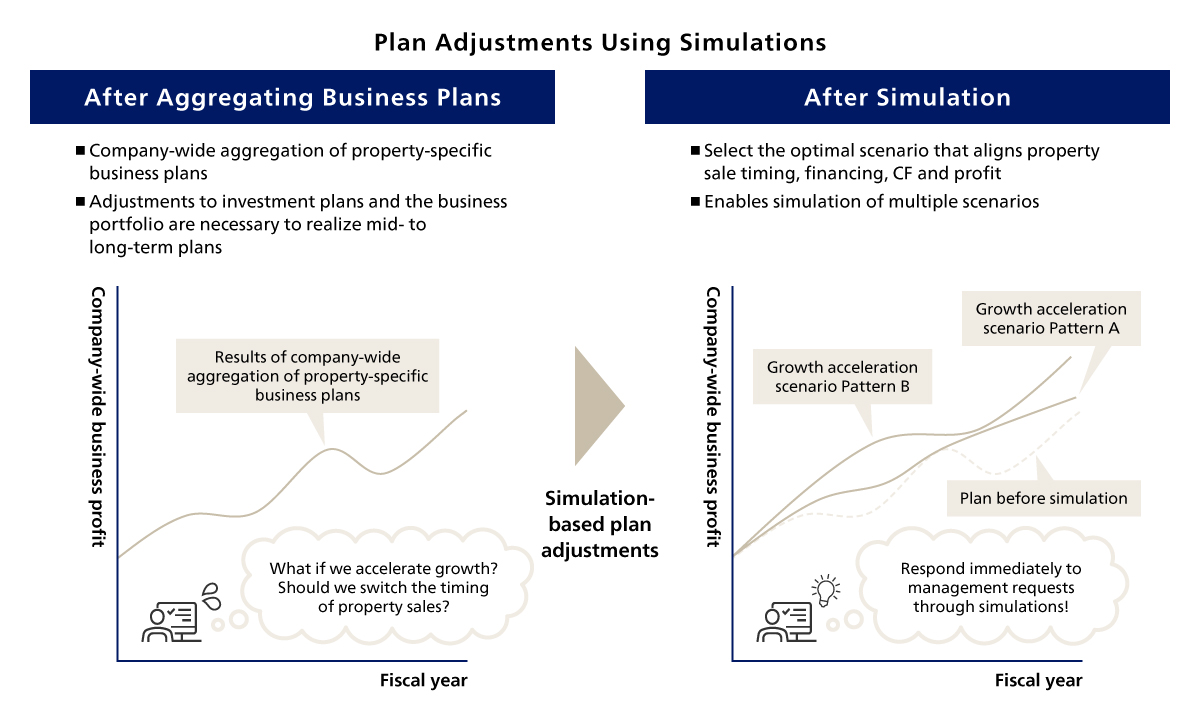 Plan Adjustments Using Simulations
ABeam’s Contribution
Supported the entire project lifecycle—from concept development and issue identification to the adoption and institutionalization of DX—as a transformation partner
ABeam Consulting provided end-to-end support as a transformation partner, covering the formulation of the overall project plan, coordination with internal and external stakeholders, business process visualization, solution selection, and the institutionalization of business transformation.
In the business process visualization phase, interviews were conducted with all relevant departments involved in mid- to long-term planning, revealing numerous issues embedded in routine operations that had long been taken for granted. In defining the target operating model with system implementation in mind, multiple options were developed and evaluated from the perspectives of business impact, cost-effectiveness, and implementation feasibility. During solution selection, ABeam facilitated the entire process—from arranging vendor demonstrations to leading discussions toward final selection.
In the system implementation phase, a development approach was adopted in which small units of actual system screens and functionalities were reviewed in iterative sessions from an early stage. Feedback was incorporated either on the spot or by the next session, enabling continuous refinement. This approach minimized rework and prevented quality issues arising from misalignment in functional understanding.
Furthermore, team members with a deep understanding of both business operations and solution capabilities maintained close communication with stakeholders, primarily within the Corporate Planning Department of Tokyo Tatemono. This enabled flexible responses to changing conditions and evolving requirements. As a result, the scope of the initiative has expanded beyond mid- to long-term planning, with ongoing support provided to drive operational efficiency, enhance business capabilities, and promote DX initiatives.
Customer Profile
- Company name
- Tokyo Tatemono Co., Ltd.
- HQ Location
- Tokyo Tatemono Yaesu Building, 1-4-16 Yaesu, Chuo-ku, Tokyo
- Estd.
- October 1, 1896
- Business
- Development, leasing, and management of office buildings, retail facilities, and others Development, sales, leasing, and management of condominiums and detached houses Sale/purchase, brokerage and consulting for real estate; parking lot development and management Leisure business, Logistics facilities development, asset management business, overseas business, and real estate appraisal
- Capital stock
- 92.4 billion yen
We are planning to relocate to "TOFROM YAESU TOWER" in the fall of 2026.
May 15, 2026
-

Jun Hiramatsu
Principal
Click here for inquiries and consultations