

Iwata Chizaki is one of the largest general construction companies based in Hokkaido and celebrated its 100th anniversary in 2022. With operations across Japan and overseas, the company has contributed to the creation of a reliable and enriched social environment through the development of social infrastructure. While it is known for its strong technical capabilities and customer-oriented approach to proposals, an employee engagement survey revealed challenges related to ways of working and internal communication, underscoring the need for an organization-wide response.
In response, since June 2024 Iwata Chizaki has been working with ABeam Consulting on a company-wide transformation initiative aimed at maintaining and enhancing the technical capabilities of its construction management engineers, who are key to the company’s sustainable value creation.
Driving everything from the formulation of human capital strategy to implementation of measures and improving the technical capacities and engagement of on-the-ground employees, beginning from an employee engagement survey
- Human Capital Management
- Real Estate/Construction/Housing
Challenge
- Ameliorating leadership and manager difficulties in accurately ascertaining what is happening on the ground at work sites that are far apart and dispersed
- Clarifying a future vision and priority issues in the human capital domain, and optimally assigning management resources
- Moving on from the style of on-the-job training (OJT) in adaptation to changes in the environment such as overtime regulations and enhanced compliance
ABeam Solution
- We visualized the state of the workplace by conducting a survey of several hundred young employees and dozens of interviews, and created a forum where leaders, field employees, and office staff could discuss issues together on equal footing.
- We formulated a 3-year human capital strategy complete with KPIs and a roadmap, organizing human capital materiality stemming from strategic business bottlenecks to embody the MVV.
- We prepared OJT manuals for field managers, their team members, and office staff, and aligned mindsets and behaviors related to their roles in people development.
Success Factors
- We enabled leadership, field employees, and office staff to develop a shared understanding of the issues and ensured fact-based decision-making, thereby building momentum to push the transformation forward.
- We identified material issues that should receive concentrated investment by clarifying the future vision for the Human Capital domain. We built consensus on these priorities with leaders through the development of a three-year Human Capital strategy.
- We launched company-wide initiatives to embed and put into practice the training mindsets and interpersonal behaviors in people development that were clarified, and established mechanisms for continuous improvement through a PDCA cycle.
Client Challenges
As the environment changes dramatically, how can companies improve on-the-ground employee technical capabilities and engagement, so that their organizations can continue to pursue their corporate missions?
Iwata Chizaki, which celebrated its 100th anniversary in 2022, is one of the largest general construction companies in Hokkaido. With a broad presence not only within Hokkaido but across Japan, and with operations overseas as well, the company has pursued its mission—“To contribute to the creation of a reliable and enriched social environment”—through the development of social infrastructure. “Reliable” reflects the company’s commitment to sincere and steady craftsmanship that supports people’s safe and comfortable daily lives. “Enriched” embodies its determination to take on regional challenges head-on and to enhance value for all stakeholders in the spirit of sanpō-yoshi (benefiting all parties). Backed by this mission, Iwata Chizaki’s high level of technical expertise and proposal capabilities has earned strong trust from society at large.
At the same time, results from an employee engagement survey brought to light challenges related to ways of working and communication, suggesting that an organization-wide response is essential amid environmental changes such as tighter overtime regulations and increasing workloads accompanying business expansion. Sustainable value creation is underpinned by people, and construction management engineers in particular are central to the company’s value proposition, as they ensure safety, quality, schedule, and cost control. It was therefore broadly recognized internally that an inadequate response to these changes could lead to declines in both engagement and technical capabilities, potentially hindering the company’s ability to fulfill its core mission.
Against this backdrop, Iwata Chizaki selected ABeam Consulting as its partner, drawing on ABeam’s proven track record of providing end-to-end support—from strategy formulation through implementation—to achieve both higher on-site technical capabilities and stronger engagement. In June 2024, the company launched a company-wide organizational transformation initiative involving both leadership and on-the-ground employees.
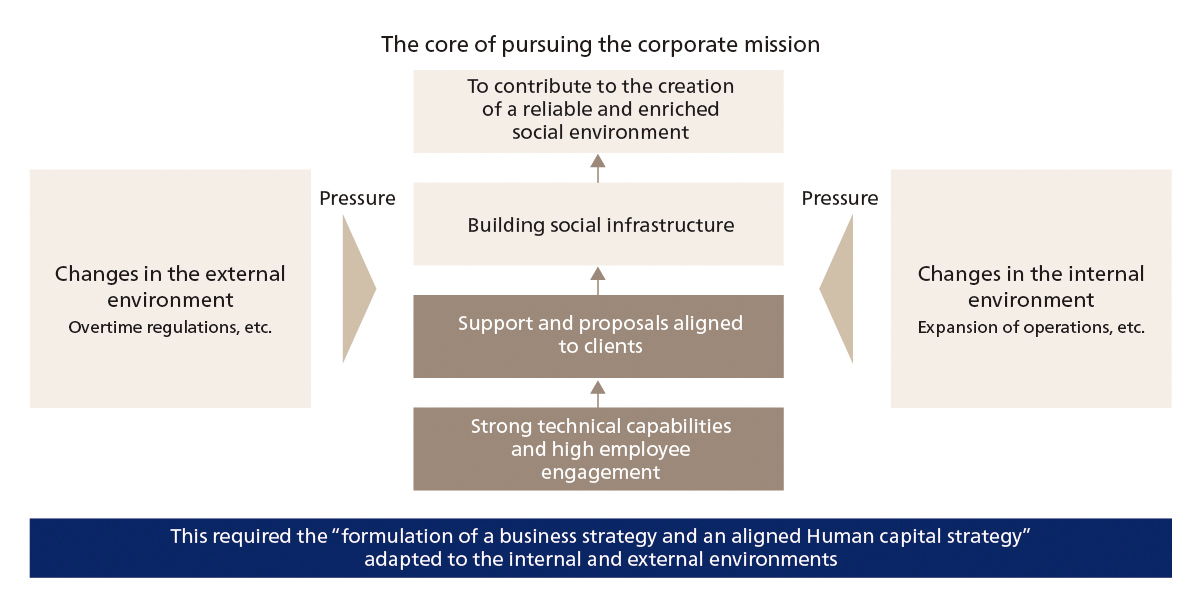 The Need to Formulate a Strategy Suited to Changes in the Environment to Pursue the Corporate Mission
Key Project Success Factors
Crafting a framework that supports development of on-the-ground employees across the organization, starting from Human Capital materiality
Under the leadership of ABeam Consulting, the company advanced and implemented the following initiatives.
Identifying “building a mechanism to expand the capacity for training on-the-ground employees” as a material human capital issue, and launching a development reform driven jointly by leadership, field employees, and office staff
The employee engagement survey revealed significant variation in development opportunities and employees’ perceived growth among on-the-ground employees. In response, as the company pursued company-wide transformation, the leadership team recognized the need to transform themselves and engaged in extensive discussions around the company’s MVV (Mission, Vision, and Value) to reaffirm its roots and clarify its future direction.
In formulating the human capital strategy, the company emphasized alignment with the business strategy and examined how to focus limited resources on priority areas. As a result, it identified “building a mechanism to expand the capacity for training on-the-ground employees” as one of its prioritized material human capital issues. Thoroughly analyzing and debating the issues based on the MVV, while also considering changes in the internal and external environment, and shaping the agenda in a way that enabled company-wide buy-in became the first step of the development reform.
Establishing a new organization-wide model to support “teaching and learning” as an urgent priority
Due to tighter overtime regulations and the need to respond to increasingly diverse employee values, managers on-site—those responsible for teaching—found it more difficult to conduct traditional on-the-job training (OJT), and even the time available for teaching itself became constrained. As a result, the situation grew more serious: “employees find it hard to grow, and managers struggle to develop them.”
Against this backdrop, the company clarified its desired future state as one in which managers, team members, and office staff think together, support one another, and learn from each other, based on the idea of strengthening not only managers’ mindsets and behaviors but also those of employees being trained, and having office staff provide close, hands-on support to field managers and their teams. To bring this vision to life, leadership, on-the-ground employees, and office staff held extensive discussions and prepared OJT manuals for field managers and their team members, as well as an office staff support manual, thereby aligning mindsets and behaviors related to their roles in people development.
Establishing a mechanism to “grow” the manuals by refining them through use in the field
The OJT manuals and the office staff support manual were positioned not as “one-and-done” documents, but as living tools to be improved through real use on-site. The manuals are operated on the premise that they will be continually refined through dialogue between on-the-ground employees and office staff. By repeatedly improving the manuals based on clearly verbalized development know-how, the company enabled the accumulation and deployment of previously individualized knowledge across the organization.
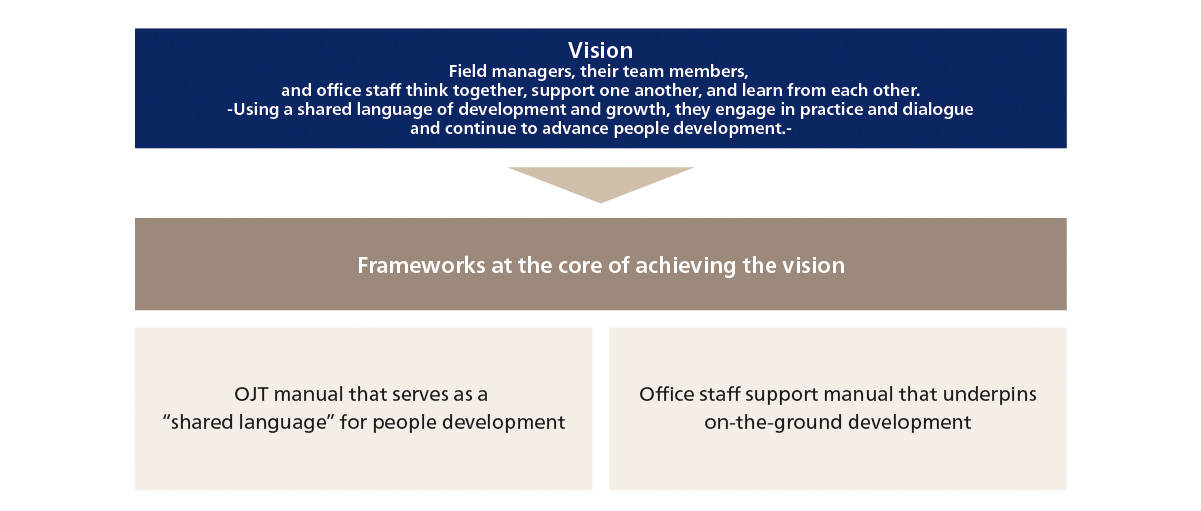 Iwata Chizaki’s Vision for Training and the Frameworks at the Center of Achieving It
ABeam’s Contribution
In driving the project, the people involved incorporate “mechanisms for generating motivation”
ABeam Consulting provided end-to-end support—from conducting the employee engagement survey and formulating the human capital strategy to supporting implementation on the ground. To deliver tangible results, the project went beyond design support and placed emphasis on ensuring genuine ownership and action by those involved, engaging leadership as well as field and office staff from the earliest stages.
Specifically, ABeam worked with leadership to clarify the company’s future direction through discussions on the MVV (Mission, Vision, and Value). ABeam also visualized on-the-ground realities through a survey of several hundred younger employees and interviews with dozens of employees, creating an environment in which leadership, field employees, and office staff could discuss issues on an equal footing. By fostering a shared understanding of the challenges and enabling fact-based decision-making, the company built momentum to drive transformation. No matter how strong a strategy or set of measures may be, it will not translate into practice without buy-in from the owners responsible for execution. For this reason, the project deliberately embedded mechanisms to foster motivation and commitment during the strategy formulation and measure design phases.
Within the human capital strategy, the team refined and articulated a material human capital issue—“building a mechanism to expand the capacity for training for on-the-ground employees”—from both top-down and bottom-up perspectives to increase specificity. In terms of measures, the company prepared OJT manuals for field managers and their team members, along with an office staff support manual, to make new values and ways of working explicit and actionable—thereby aligning mindsets and behaviors related to their roles in people development and enabling each stakeholder group to act with a sense of ownership. True organizational transformation has only just begun. ABeam Consulting will continue to work side by side with Iwata Chizaki as its partner in pursuing the company’s mission.
The company was created in 2007 through the merger of two firms. However, as the construction industry continued to face challenging conditions for an extended period, the company felt that its sense of purpose, strategic direction, and shared values had gradually become diluted. As it approached its 100th anniversary in 2022, the company therefore formulated its Mission and Vision and reinterpreted its existing corporate Value (the company creed).
Even so, these principles did not fully take hold across the organization. With the company at risk of losing the strengths and distinctive qualities that had defined it—and with employee turnover remaining persistently high—it decided to embark on this project.
Together with ABeam Consulting, the company revisited its history, assessed the internal and external factors shaping its current situation, and clarified its strengths and weaknesses to identify key issues. This enabled the company to share the MVV (Mission, Vision, and Value) across the organization, strengthen its on-the-ground responsiveness as well as its proposal and solution capabilities—areas that had long been core strengths—and take action on initiatives in a clearly prioritized manner.
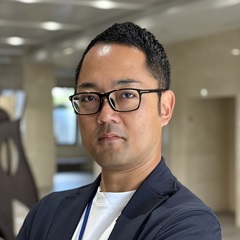
Iwata Chizaki Inc.
Representative Director, Vice President and Executive Officer, Head of Corporate Planning
Koji Iwata
Before joining the Corporate Planning Department, I worked in Human Resources and witnessed firsthand the challenges we faced, such as increasing difficulty in hiring construction management professionals and a rising number of resignations. While today’s labor market makes it both harder to hire and easier for employees to leave, I believe we should create an environment where those who choose to join our company can continue working with us for as long as possible.
As part of this effort, we decided to conduct an employee engagement survey to strengthen retention—accurately identify the underlying issues, develop strategies aligned with those issues, and implement the necessary measures swiftly.
With the support of ABeam Consulting, we were able to take a consistent, end-to-end approach—from strategy formulation through to implementation—while engaging a wide range of stakeholders, including leadership and employees on the ground. Since an MVV (Mission, Vision, and Value) alignment initiative was running in parallel, ABeam took the time to deeply understand our history since founding and provided highly relevant, well-grounded advice based on extensive experience, which I found very reassuring.
Looking ahead, I believe continuity is the most important factor for success, and we will continue to move forward as one company to sustain these efforts.
Iwata Chizaki Inc.
Corporate Planning Department, Corporate Planning Section, Section Chief
Ryo Watanabe
Customer Profile
- Company name
- Iwata Chizaki Inc.
- HQ Location
- Kita 2-jo Higashi 17-2, Chuo-ku, Sapporo
- Estd.
- 1922
- Business
- general contractor
- Capital stock
- 2 billion yen
Jan 7, 2026
-
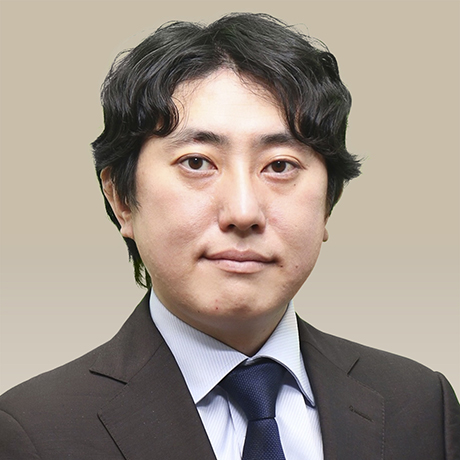
Kazuki Sato
Director

Click here for inquiries and consultations