

A major logistics company sought to achieve advanced decision-making by management and human resources departments based on data, with the goal of continuously developing talent and placing the right people in the right roles to enhance corporate value. However, although talent data indicating employee experience and skills had been accumulated in the talent management system, the data varied in granularity and structure and was not readily usable for decision-making. With support from ABeam Consulting, the company established a semantic layer that translates employee-submitted data into business-meaningful information for decision-making and built a data utilization platform with the future use of AI in mind. The company is promoting a transformation to a business foundation for data-driven talent decisions rather than relying on intuition in the field.
Enhancing a Talent Data Platform by Transforming Employees’ Career Experience into Decision-Ready Data
- Transportation/Logistics
- DX
- Human Capital Management
Customer Profile
- Industry
- Logistics business
- Scale of Revenue
- Undisclosed
- Number of Employees
- Undisclosed

Challenge
- Insufficient talent data for decision-making made it difficult to make data-driven decisions on personnel assignment and development
- Talent data containing narrative information, such as free-text responses, had not been structured for comparison and utilization
ABeam Solution
- Establishment of a semantic layer that balances the employee data-entry experience at the time information is generated with its utilization in decision-making
- Establishment of a data utilization platform with the future use of AI in mind
Success Factors
- Supported more advanced data-driven decision-making by standardizing personnel action data and employee career experience data to enable meaningful comparison
- Contributed to reducing Total Cost of Ownership by enabling the generation, processing, utilization, and centralized management of talent data using only the standard functions of a cloud-based talent management system
Client Challenges
Realizing Talent Decision-Making Based on "Data" Rather Than "Frontline Intuition"
At the major logistics company, talent data had been accumulated through the integration of personnel action, payroll, and attendance information from various human resources systems, as well as through various activities conducted within the talent management system, such as performance evaluation and training. However, information regarding employee experience and preferences was insufficient for utilization in decision-making by management and human resources departments, making it necessary to rely on frontline managers with direct knowledge of individual employees when making decisions such as transfers and assignments. Although field-based judgments rarely resulted in errors, they made it difficult to identify overlooked talent and could lead to perceptions of unfairness resulting from information gaps. As a result, the company needed to establish a mechanism to define and collect data on experience and preferences and manage it in a form that could be utilized for decision-making. In response to these management challenges, ABeam Consulting, acting as a hands-on partner responsible for supporting the initiative from planning through execution, advanced this effort through the following three themes.
- Definition and Collection of Talent Data Intended for Utilization
Information such as experience and preferences that had not previously been sufficiently utilized was defined as data items necessary for decision-making, and a mechanism was established to collect responses from employees. - Converting Unstructured Data into a State Suitable for Utilization
The utilization of talent data requires not only aggregation but also the contextualization needed to make diverse talent data comparable. For example, even if experience information is collected, it cannot be compared if the level of detail and periods vary, causing the data to go unused. The inability to fully utilize collected and integrated data is a common challenge among many companies, and this initiative similarly addressed the need to contextualize data. - Measures for Utilizing Data in Business Operations
The talent data required, as well as the manner in which it should be presented, differs according to the roles and responsibilities of those utilizing it. Even within personnel assignment decisions alone, there are multiple use cases, including assignment to key positions, selection of overseas assignees, and rotational assignments for new employees. Before this initiative, "the large variety of data types and the lack of clarity regarding which data should be used" constituted a barrier to utilization. Therefore, use cases were organized, and a mechanism was established that enabled responsible personnel to easily access the information they needed. This made it possible to present data in an optimized manner for each user and supported practical utilization in the field.
Key Project Success Factors
Designing a Semantic Layer That Connects the "Generation" and "Utilization" of Data Based on Business Context
The database of the talent management system was designed as a general-purpose database for organizing and storing information and could accommodate both generation and utilization of data to a certain degree; however, it was not optimized for either purpose. Therefore, this initiative was based on the concept that "the optimal databases for data generation and data utilization are different." In the generation phase (data collection from employees), a user-friendly database was developed with a limited number of input items to facilitate ease of entry. This improved both completion rates and the quality of employee input. Meanwhile, in the utilization phase, a database was established that could manage more specialized items in a comparable format to support diverse decision-making needs. The enhancement of meaningfully defined data items also expands the potential applications of AI.
The most critical success factor of this project was the establishment of a semantic layer that connected data generation and utilization through business meaning by designing databases optimized for each purpose.
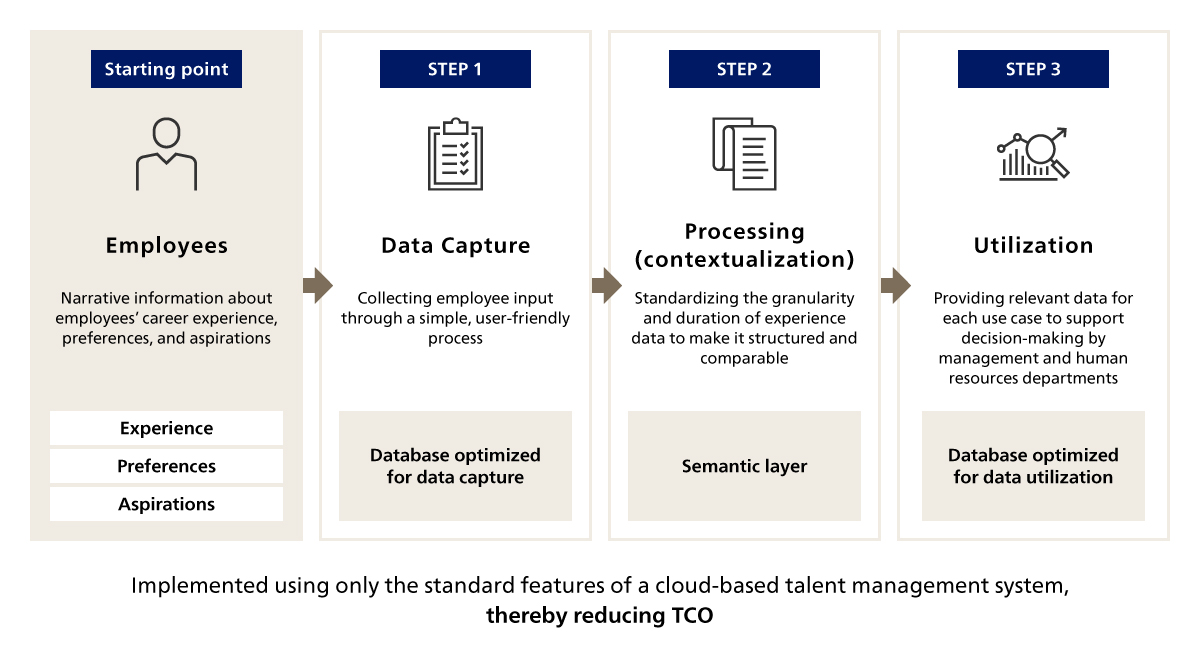 Semantic Layer Connecting the "Generation" and "Utilization" of Data
ABeam’s Contribution
Building a Business Foundation for Data-Driven Talent Decisions by Contextualizing Employees’ Career Experience
Through this initiative, employees’ career experience was contextualized and transformed into standardized, comparable data, enabling organization-wide visualization and comparison of talent across the company. As a result, personnel transfer and assignment decisions that previously relied on field intuition can now be made based on data. Furthermore, the solution was realized using only the standard functions of a cloud-based talent management system, without relying on custom add-on development or customization. This reduced the burden associated with additional development and ongoing maintenance and contributed to lowering Total Cost of Ownership, including system implementation, operation, and maintenance costs.
Going forward, the company will further advance talent management as a business foundation for data-driven talent decisions by leveraging the established talent data foundation for capabilities such as AI-based skill estimation, optimal personnel assignment, and the enhancement of global talent strategies. ABeam Consulting will continue to support initiatives that develop corporate talent management into core business infrastructure by applying the knowledge accumulated through long-term, hands-on partnership support rather than merely implementing systems.
Sep 7, 2026
-

Takashi Sakamoto
Principal
Click here for inquiries and consultations