

Co-creating exceptional customer experiences in Japan and achieving sustainable corporate growth
Brand Communication Begins with Customer Understanding — "Brand Value Proposition Definition" for Designing Value and Connecting It to Strategy

Co-creating exceptional customer experiences in Japan and achieving sustainable corporate growth
Japanese consumers are widely regarded as having some of the most exacting standards for customer experience and the services they receive from companies. While globally, promptness in responding to questions and transactions (i.e., efficiency) is highly valued, in Japan the greatest emphasis is placed on sincere, attentive service (detail orientedness). For this reason, directly applying advanced global methods for driving efficiency in Japan does not always guarantee success.
To improve their customer experience value (CX), companies must generate customer value through a deep understanding of their customers, and continuously improve their customer experiences through real-time customer insights. For sustainable corporate growth, companies must also improve productivity by leveraging leading technologies to provide customer experiences and building efficient and effective value delivery schemes, such as by making concentrated investments of human capital on customer service that requires detailed handling.
As a consulting firm originating fromJapan and Asia, ABeam Consulting provides end-to-end support to clients for everything from formulating a customer strategy to implementing transformation, including organizational change, technology adoption, and global expansion. We stand ready to help clients achieve sustainable corporate growth based on our extensive track record in customer experience transformation in the Japanese market, one of the most demanding in the world in this area.
Brand Communication Begins with Customer Understanding — "Brand Value Proposition Definition" for Designing Value and Connecting It to Strategy
AI Agents as a Management and Business Strategy Issue: The Future Vision of Financial Institutions Seen Through the Customer Interface
AI Optimization: Redefining Customer Choice in the Insurance Industry
CX transformation accelerated by Direct to Fan (D2F) × Entertainment-Driven Consumption: Fan Types and Consumption Behavior Observed from Sports Fans (Part 2)
ABeam Consulting Named One of the World’s Best Management Consulting Firms 2026 by Forbes
Developing strategies to enhance customer value and maximize revenue efficiency
To achieve sustainable growth, it is essential for companies to continuously enhance their value through customer insight and relationships of trust, and strengthen customer relationships. They must also maximize revenue efficiency when providing customer value and continuously improve efficiency in the use of management resources.
Simply revising products and services or improving customer touchpoints such as UI or UX is not enough to improve customer value. To build competitive advantage in customer value, companies must clarify the underlying reasons for customer behavior before redefining their value proposition and revising their entire customer experience based on that insight.
To maximize revenue efficiency, companies must enhance cost efficiency through integrated management of customer-facing departments, data-driven decision-making, and the automation of operational processes, achieved by optimizing organization-wide activities and leveraging advanced technologies such as AI. Companies established in Japan should also diversify their revenue streams by systematizing superior customer experience practices honed in the Japanese market and extending them to global markets.
To establish sustainable growth, organizations should create roadmaps that strategically enhance customer value and optimize revenue efficiency, rather than making partial improvements to customer experiences or repeatedly attempting to streamline operations in isolated customer touchpoints or departments.

Deriving customer insights and constructing an improvement cycle for the customer experience
To appeal to informed modern customers who have many options available amid an overabundance of goods and information, companies need to provide the value sought by customers based on thorough customer insight. Because the market environment and customer values change constantly, as seen in the heightened awareness of social issues symbolized by the SDGs, companies also need to maintain real time understanding of their customers.
Meanwhile, even though companies have all sorts of data about their customers, they often sturuggle to make effective use of it. We often see issues where companies do not sufficiently define or gather the data required for customer insights, slow progress in implementing and utilizing data platforms and analytics technologies, suffer from organizational silos that make applying data to customer insights difficult, fail to make progress in formulating strategies and tactics based on customer insights, and/or fail to apply a continuous PDCA cycle.
To continuously generate the value customers seek at the organizational level, companies should establish cycles that both improve the customer experience and generate insights combining depth with immediacy. This requires building platforms to gather, integrate, and analyze customer data in real time from across the company or group.

Creating a Seamless Customer Experience Across Organizational and Departmental Boundaries
In addition to the functional and practical value provided by the features and capabilities of a product or service, customers make purchasing decisions by holistically assessing the emotional and psychological value they gain through various touchpoints with a company. To improve customer value, it is important for companies to not only provide a unique customer experience based on customer insight, but also to provide a consistent, seamless, and effortless customer experience across all touchpoints.
It is important to redefine all customer touchpoints across the company and its business partners (including distributors) and to orchestrate integrated physical and digital channels, including advertising media, physical stores, e-commerce sites, digital portals, apps, contact centers, and social media. The source of business value lies in the ability to go beyond optimizing any single channel to create a customer experience that enables customers to navigate smoothly and without friction at any touchpoint. To create such a seamless customer experience, it is essential to integrate data that is fragmented across different companies, departments, and systems to design a truly customer-centric experience. By combining customer data from marketing, sales, customer support, and business partners, leveraging these assets across the organization, and building an ecosystem that connects the customer experience will allow companies to create a truly customer-first experience.
To continuously improve the customer experience, companies must quantitatively measure the experience and establish mechanisms for continuous improvement. The customer experience is not a one-time effort. It is a “business resource” that must flexibly evolve to respond to customer expectations and changes in the market environment. To take on this challenge across the entire organization, companies must design performance indicators and build a PDCA cycle to pursue improvements to their intellectual and relational capital and enhance the value of their non-financial capital.
Viewing the customer experience not as a vague feeling but as a measurable and actionable initiative—and continuously improving it across the organization—is the key to future competitiveness.

Realizing Value Chain Transformation Aligned with Customer Experience
Customers expect personalized services, swift response, and seamless purchasing experiences. To continue appealing to customers and maximizing revenue efficiency, companies need to transform their entire value chain by integrating demand chain transformation—which captures customer needs—with supply chain transformation—which swiftly addresses those needs.
While many companies recognize the importance of a company-wide, customer-first value chain transformation, they face significant challenges in achieving it. A major cause is the siloed nature of customer-facing departments such as marketing, sales, and customer service, which result in outdated processes and structures that focus on achieving targets or KPIs per department or customer touchpoint. To break down outdated organizational structures while enhancing customer value and maximizing revenue efficiency, introducing Revenue Operations (RevOps)—a company-wide operating model for integrated data and process management—is highly effective. When introducing RevOps, it is essential for companies to redesign their operational model and systems frameworks to achieve inter-organizational coordination, foster a culture and cultivate talent to support customer-first coordination, in addition to revising organizational structures and evaluation systems. For companies to successfully transform, leadership must thoroughly recognize the necessity of the transformation and lead the way in company-wide organizational transformation, aligning front and back office functions.

Enhancing Value and Productivity with Technology
As Japan’s working-age population continues to decline, companies must simultaneously boost productivity and enhance the customer experience. Achieving this requires leveraging technology to streamline operations and generate new value—by automating routine tasks, accelerating decision-making through data and AI, and delivering personalized experiences tailored to each customer. At the same time, it is unrealistic to manage every customer interaction solely through technology. High-value engagements call for a focused investment in human capital.
In recent years, many organizations have adopted advanced tools—such as CDP, MA, SFA, and BI—to capture customer behavior in real time, enabling them to engage through the right channels at the right moments, while creating new value and enhancing the value of existing offerings. However, blindly adopting cutting-edge technologies based on global success stories can backfire, undermining both productivity and the customer experience. To avoid this, companies must carefully select and implement technologies that match their specific business characteristics and stage of maturity. Moreover, genuinely improving the customer experience requires strengthening collaboration not only at customer touchpoints but across the entire value chain. This calls for redesigning and rebuilding system architectures holistically, including backend systems.
Effective use of technology is critical to sustaining competitiveness. Reviewing systems with a view toward overall optimization lays the foundation for stronger execution capabilities and an enhanced customer experience.

ABeam Consulting supports companies and organizations in achieving sustained growth across a wide range of industries. We use industry-specific customer insights based on years of industry knowledge, and provide reliable services backed by extensive experience.

ABeam Consulting supports transformation across the entire value chain, going beyond marketing, sales and customer service to extend into supply chain, finance, and HR. Our process starts with a firm understanding of the customer by analyzing customer behavior data.

ABeam Consulting works with clients to provide end-to-end support across strategy formulation, organizational and operational transformation, and implementation and execution of technology to create business outcomes through transformation. Our approach uses specialist insights based on a strong track record in marketing, sales and customer service, and organic collaboration with experts.

To remain competitive in today’s digital-first business landscape, customer experience has become an important enhancement in order to stay ahead. Businesses in Malaysia are looking for a unified view of their customers, streamlined processes, and data-driven decision making.
At ABeam Consulting, we help companies implement robust CRM software and CRM systems in Malaysia that strengthen customer relationships, improve sales performance, and deliver consistent service across every touchpoint.
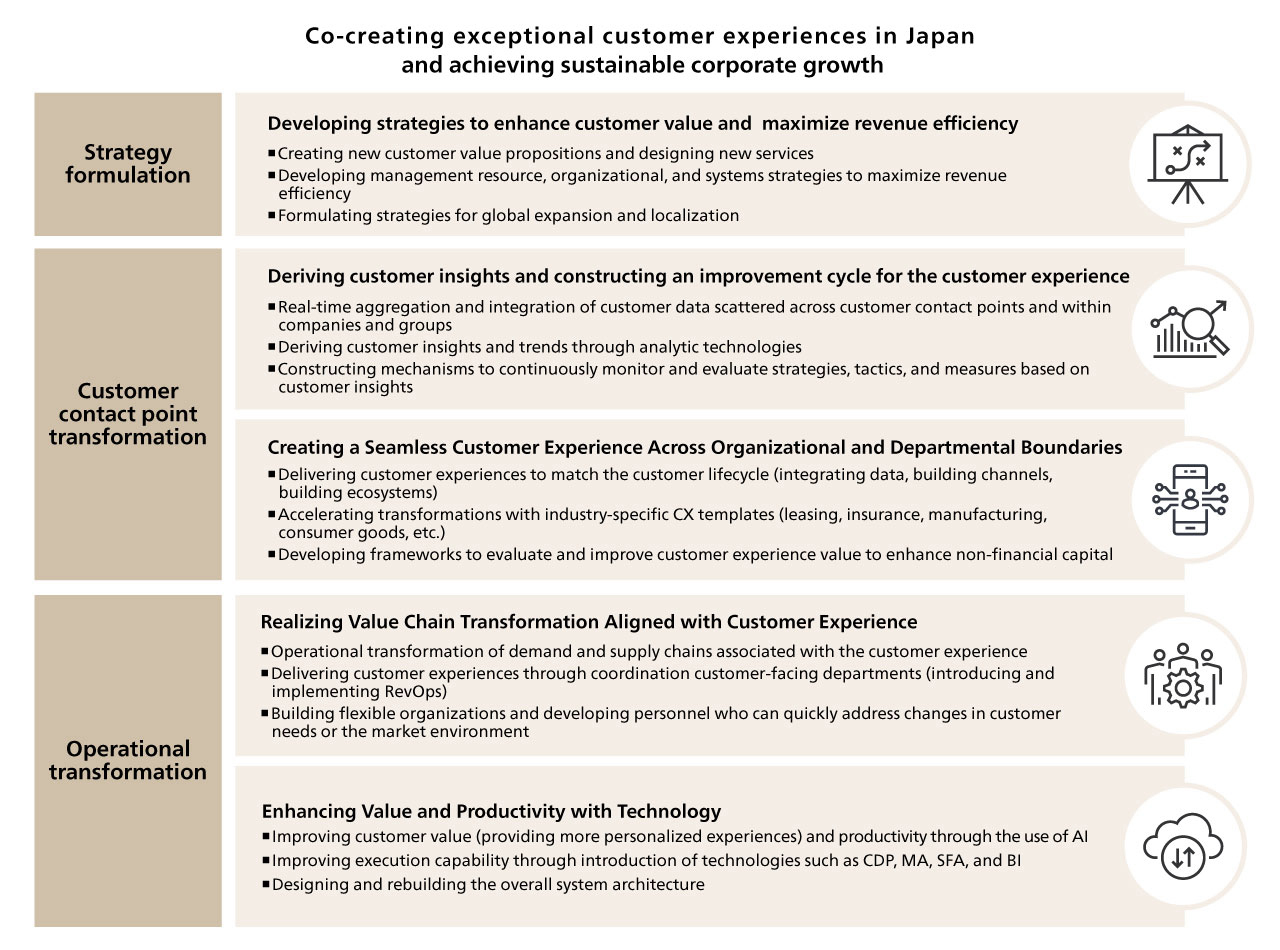
ABeam Consulting Malaysia supports organisations in transforming customer experience across strategy, touchpoints, operations, and technology. This way, we ensure Malaysian businesses strengthen engagement, maximise revenue opportunities, and scale customercentric operations.
We help businesses create customer-focused strategies that boost growth and strengthen revenue. This includes identifying what customers value most, designing better services, and organising your teams and processes so your CRM system in Malaysia works effectively.
We streamline customer data across channels and apply analytics to uncover behaviour patterns, needs, and trends. By integrating insights into your CRM software in Malaysia, businesses can continuously improve customer experience while personalising interactions for added value.
We design end-to-end customer journeys that deliver a consistent experience across teams and touchpoints. This includes integrating data, aligning cross-functional processes, and using industry-specific CX (Customer Experience) frameworks to accelerate CRM and digital transformation in Malaysia.
With the ever-evolving customer expectations, sales, marketing, service, and supply chain processes will also have to align with the changes. With operational coordination and cross-department collaboration, your CRM system becomes crucial for delivering efficient, customer-focused operations.
We implement and modernise CRM-related technologies such as marketing automation, CDP (Customer Data Platform), SFA (Salesforce Automation), and analytics tools. By strengthening your technology architecture and embedding AI and automation, your CRM software becomes a scalable platform for improved productivity and personalised engagement.
Field Sales Reform Solution to Accelerate DX of Consumer Business (Japanese)
Real/Digital Hybrid Marketing Platform for Insurance Companies to Succeed in the Age of the “New Normal” (Japanese)
AI Communication Measure Implementation Support Service for Credit Card Companies (Japanese)
Advanced Debt Collection Solution with AI (Japanese)
Advanced Sales Activity Support Service by Implementing Event-Based Marketing (EBM) for Regional Financial Institutions (Japanese)
Fundraising (Collection & Management) Solution (Japanese)
Sponsorship Sales Operations Re-engineering Service with Specialized Sales Force Automation Tool
RevOps (Revenue Operations) Implementation Support Service: A Service to Drive Customer Engagement and Maximize Revenue Efficiency
Powering Front-End Excellence with CX Integrated Platform Support Service (Japanese)
Support Service to Maximize Advertising Effectiveness (Japanese)
Digital Transformation (DX) support on E-Commerce business
Adobe Experience Cloud Consulting Service
Adobe® Experience Manager Quick Start Service (Japanese)
Business Performance Forecasting Support Service for Action by Sales Support System “Sales Force Automation (SFA) + Infrastructure System” (Japanese)
Intelligent Field Sales for Efficiency and Productivity with Vymo
Customer Touchpoint Reform Solution for Retail Facilities Using Mobile Applications to Encourage Action (Japanese)
Support Service to improve Online Shopping Experience Through Video Content (Japanese)
ABeam Cloud® CX Express Customer ID Management Solution (CIM) (Japanese)
Service Design
Business Transformation and New Business Creation Support Service by Encouraging Partnerships Between Organizations Across Industries (Japanese)
Direct to Consumer (D2C) Support Service (Japanese)
Digital Commerce Sales Expansion Support Service (Japanese)
Integrated Sales Launch Support Service (Japanese)
Support Service for Customer Success Planning and Implementation for BtoB Companies (Japanese)
We combine international CRM transformation experience with a deep understanding of Malaysian business environments.
Our structured implementation framework reduces risks and ensures predictable outcomes.
We bring CRM expertise across banking, retail, manufacturing, telecommunications, healthcare, and more.
From strategy to implementation and managed services, we provide complete CRM lifecycle support.
Whether you're selecting your first CRM or upgrading to an enterprise-class CRM system, ABeam Consulting helps you achieve measurable improvements in customer experience, sales performance, and operational efficiency.
Umios Corporation
Promoting Data-Driven Management through Evidence-Based Sales Transformation and Sales DX

Yamaha Music Japan Co., Ltd.
Supporting transformation to enhance LTV and maintain customer connections Planning new services and driving integration of digital channels with directly managed stores/schools

Absolutely. A modern CRM system integrates seamlessly with ERP platforms, as well as accounting, billing, marketing automation, and customer service tools. Integration ensures unified data and streamlined workflows.
CRM software helps Malaysian organisations improve customer service, increase sales efficiency, strengthen retention, automate workflows, and gain real-time visibility into the customer lifecycle. It also ensures better alignment between sales, marketing, and service teams.
CRM systems are used by sales teams, marketing teams, customer service departments, contact centres, and account management teams. Management also benefits from analytics dashboards and customer insights.
Yes. A modern CRM system supports multiple channels including email, WhatsApp, social media, websites, call centres, and physical branches. This provides a consistent experience across the entire customer journey.
Yes. CRM software can automate repetitive tasks such as lead assignment, follow-up reminders, case routing, campaign execution, and approval flows, helping teams work faster and more consistently.
Click here for inquiries and consultations