


As a leading real estate developer with operations in Japan and overseas, Mitsubishi Estate is pursuing a “core logistics concept” geared to next-generation mobility to help address social issues such as the “2030 logistics problem”—the projected shortage of line-haul transport capacity resulting from an aging driver population. Leveraging its expertise in the logistics industry, ABeam Consulting supported Mitsubishi Estate in implementing this concept by helping define the business model, business processes, and system architecture. Based on the business overview, system architecture, and roadmap developed through this project, Mitsubishi Estate plans to conduct a proof of concept (PoC) in the second half of fiscal 2026 and will continue its efforts toward the development of core logistics facilities.
Developing a concept for core logistics facilities for next-generation mobility Helping address logistics challenges through the automation and improved efficiency of line-haul transport
- Supply Chain Management
- Transportation/Logistics


Challenge
- Need to redefine the role of logistics facilities as part of a new value creation model that extends beyond conventional real estate development in response to structural changes in the logistics industry
- Need to redesign the entire transport network, including logistics hubs, as traditional approaches based on local optimization and facility-level efficiency improvements were no longer sufficient to address driver shortages and constraints on line-haul transport
- Difficulty in turning a future concept based on next-generation mobility and collaborative logistics into a concrete, feasible business plan rather than merely a vision
ABeam Solution
- Organizing the logistics structure based on next-generation mobility and collaborative logistics, and supporting the development of the business concept for the entire transport network centered on core logistics facilities
- Defining the roles and responsibilities of multiple stakeholders and the prerequisites for system and data integration based on an understanding of the logistics industry’s structure and expertise in IT concept development, while supporting the development of a feasible overall design integrating the business model and business processes
Success Factors
- Organized the core logistics concept as an integrated business concept encompassing the redesign of the transport network, and clarified the roles and functions of logistics hubs
- Developed an implementation roadmap, including the system architecture and PoC plan, to realize the concept, and established a foundation for decisionmaking to advance the project
Project Background
A concept for line-haul transport using core logistics facilities for next-generation mobility
Mitsubishi Estate Co., Ltd. is a leading real estate company engaged in the development, leasing, operation, and management of offices, retail properties, hotels, and logistics facilities, as well as overseas business, investment management, airport operations, design and construction supervision, real estate brokerage, and area management. Under its group mission—“Contribute to society through Machizukuri (urban development),” the company has adopted “Be the Ecosystem Engineers,” as set out in Sustainability Vision 2050, as the common guiding policy for both its social value enhancement strategy and shareholder value enhancement strategy under its long-term management plan. Based on this policy, the company is addressing various social issues.
In recent years, the logistics industry has faced significant challenges, including driver shortages and the prospect of future transport capacity constraints resulting from an aging workforce. Japan’s logistics network is supported by approximately 60,000 transport companies, and the Ministry of Land, Infrastructure, Transport and Tourism estimates that there will be a shortfall of about 34% in the transport capacity needed in 2030. “Long-distance transport, in particular, poses a major challenge, and we expect that even routes between Tokyo and Osaka will become difficult to operate in their current form,” says Mr. Yuto Katsuragi, Head of Core Logistics Business Promotion Office, Logistics Facilities Development Department, Mitsubishi Estate. “Logistics companies have responded to the driver shortage associated with the ‘2024 logistics problem’ through modal shifts and relay systems, but the issue has yet to be fundamentally resolved. In the long term, the transportation system itself will need to be redesigned.”
Against this backdrop, Mitsubishi Estate has launched a concept for developing core logistics facilities directly connected to expressway interchanges. These facilities would incorporate functions such as mobility pools for coupling and decoupling autonomous trucks and open cross-docking facilities for transferring freight between autonomous trucks engaged in line-haul transport and driver-operated trucks handling regional delivery. The concept aims to address the challenges facing line-haul transport through the use of next-generation mobility technologies such as Level 4 autonomous trucks.
Furthermore, the company has invested in T2 (Chiyoda-ku, Tokyo), a developer of autonomous driving systems, and is conducting demonstration projects aimed at realizing line-haul transport using Level 4 autonomous trucks linking core logistics facilities. “As a real estate company, we have traditionally focused on developing and leasing logistics facilities. With this initiative, however, we aim to go beyond that. By combining systems and automation technologies with logistics facilities, we believe we can create next-generation mobility-ready core logistics facilities by leveraging Mitsubishi Estate’s strengths—its relationships with numerous shippers and logistics companies, together with its expertise in logistics facility development,” says Mr. Katsuragi.

Through our ongoing discussions, we have developed a deeper mutual understanding, and we look forward to continuing to work with ABeam as a partner in transforming logistics, with line-haul transport at its core.
Head of Core Logistics Business Promotion Office
Logistics Facilities Development Department
Mitsubishi Estate Co., Ltd.
Yuto Katsuragi
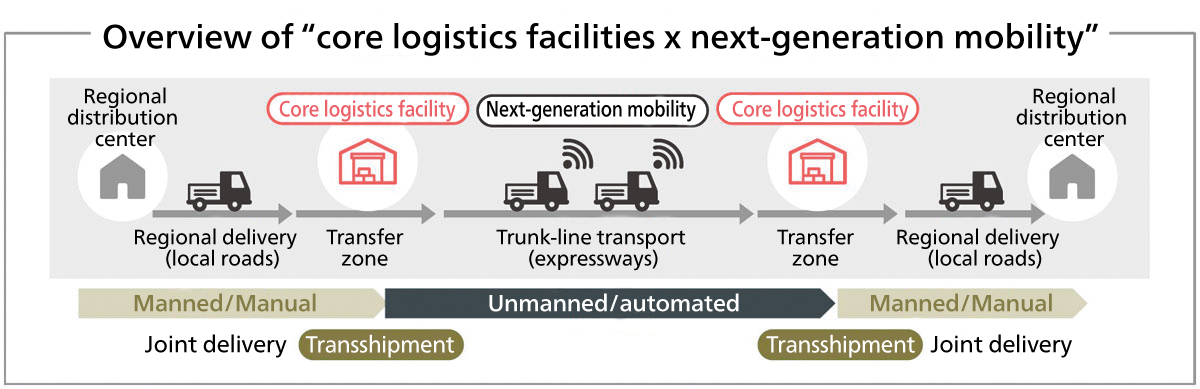 Source: Mitsubishi Estate Co., Ltd., Core Logistics Concept: Toward the Development of Next-Generation Core Logistics Facilities Designed to Address Social Challenges and Support Next-Generation Mobility
Why ABeam
A highly feasible proposal backed by expertise in the logistics industry and IT
To ensure the smooth operation of core logistics facilities, it is essential to design an end-to-end logistics framework spanning transportation, facilities, and all relevant stakeholders, seamlessly connecting autonomous trucks with shippers, logistics providers, and all other participants across the logistics ecosystem. Developing the system architecture that would serve as the foundation for this framework therefore became a key challenge. However, it was not easy for Mitsubishi Estate to develop such an architecture on its own. The company therefore decided to partner with a consulting firm possessing expertise in both logistics operations and IT to develop system architecture that would define the desired future state of core logistics facilities.
Mitsubishi Estate invited proposals from several consulting firms and conducted a competitive selection process. After approximately three months of discussion and evaluation, the company ultimately selected ABeam Consulting. The primary reason was ABeam’s extensive expertise in both logistics and IT systems, enabling it to develop the business concept and system architecture in an integrated manner. Effectively connecting logistics operations with IT systems requires a thorough understanding of industry-specific practices and the ability to reflect them in systems. ABeam’s proposal was highly regarded in this respect. In addition, the company was impressed by ABeam’s strong facilitation skills and responsiveness throughout the selection process.
“We asked the candidate consulting firms to submit proposals focusing on two areas: autonomous truck guidance and open cross-docking. In response, ABeam proposed that we concentrate on the more challenging issue of open cross-docking. The decisive factor was ABeam’s clear vision of the business we were seeking to realize and its accurate understanding of the challenges involved,” says Mr. Shohei Takayanagi, Manager of the Logistics Value Creation & Strategy Unit / Core Logistics Business Promotion Office, Logistics Facilities Development Department, Mitsubishi Estate.
Project’s goals, challenges, and solutions
Sharpened the definition of the challenges and clarified the goals through ongoing dialogue
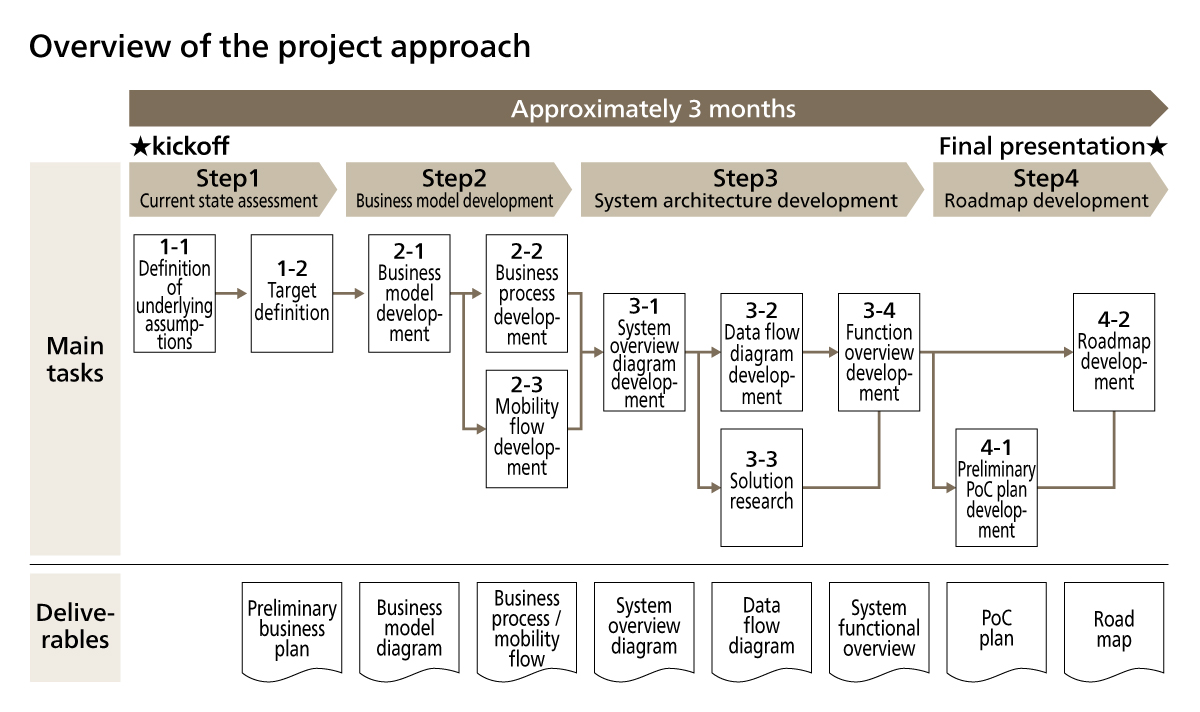
The project to support development of the system architecture for the core logistics concept was carried out over approximately three months, from October 2025 to January 2026. It began with defining the business model, followed by examining system requirements and functions, and sharing case studies on open cross-docking. The project culminated in the development of the scope and scenarios for the proof of concept (PoC), together with an overall roadmap.
The project was unprecedented even for Mitsubishi Estate, and there are virtually no comparable examples anywhere in the logistics industry. As a result, neither existing logistics models nor conventional real estate development frameworks could be applied. It was therefore necessary to determine the most appropriate business model while simultaneously defining multiple underlying assumptions.
As the sessions progressed, issues that had been unclear during the conceptual stage gradually came into focus, and the business model became increasingly well defined. Throughout the discussions, ABeam presented what it considered to be the most appropriate approach for each phase and shared examples of similar initiatives undertaken by other companies, highlighting their key features and challenges. Building on these insights, the team systematically developed a set of working hypotheses on the measures to be considered for the open cross-docking initiative within the core logistics concept, providing a foundation for more in-depth discussion.
Through ongoing dialogue between Mitsubishi Estate’s project team and ABeam’s consultants, the key issues to be addressed were progressively refined, ultimately leading to a clear vision of the desired future state. “We communicated with the consultants frequently. Even outside the formal sessions, whenever I shared an idea via chat, I received an immediate response, which helped build a strong relationship of trust. As a result, I feel that our discussions during the sessions became even more active and productive,” says Mr. Takayanagi.

Going forward, we would like ABeam to continue supporting us in various areas, including partnership arrangements for the operation of open cross-docking facilities.
Manager
Logistics Value Creation & Strategy Unit / Core Logistics Business Promotion Office
Logistics Facilities Development Department
Mitsubishi Estate Co., Ltd.
Shohei Takayanagi
Results and future prospects
PoC planned for the second half of fiscal 2026, marking a step toward the transformation of line-haul transport
As a result of extensive discussions, the overall system architecture for the core logistics concept was defined, and the required functions were clearly identified. Initially, Mitsubishi Estate commissioned ABeam to develop the system architecture. However, by extending the scope of the project to include the business model and business processes, the team was able to identify the issues concerning the overall concept. This was one of the project’s most significant achievements.
Another important achievement was the development of a schedule leading up to the construction of the core logistics facility, providing a clear roadmap for realizing the concept. Although there was widespread recognition within Mitsubishi Estate that entering the new field of trunk-line logistics would not be easy, the project’s findings helped build internal support for commercialization, providing a significant stepping stone toward bringing the business to fruition.
“At the outset of the project, we felt that there was still plenty of time before 2030. However, by the time we had completed our review, we had come to realize that we would not achieve our goal unless we began working with a partner possessing the necessary expertise as early as possible. The fact that we were able to examine everything in depth—from the business model and open cross-docking to collaborative partnerships—earned the project very high praise within the company, including from senior management,” says Mr. Katsuragi.
As the project progressed, the team came to recognize that the logistics industry remains heavily dependent on manual operations and continues to be constrained by inefficient practices, including long-established business customs and order processing that still relies primarily on fax and telephone. Even in line-haul transport, a number of challenges remain, including securing sufficient cargo volumes. At the same time, the industry is entering a transitional phase in which line-haul transport is becoming more efficient through the use of next-generation mobility solutions, including core logistics facilities equipped with open cross-docks, autonomous trucks, and double-trailer trucks. “We hope this project will serve as a catalyst for expanding communication and collaboration with stakeholders across the logistics industry and ultimately contribute to transforming Japan’s logistics system as a whole,” says Mr. Takayanagi.
Mitsubishi Estate plans to develop detailed scenarios during the first half of fiscal 2026, with the aim of conducting a PoC in the second half of the fiscal year. The PoC is positioned as a key milestone toward realizing open cross-docking and is expected to address a wide range of issues, including operational methods. Going forward, Mitsubishi Estate will continue working with ABeam as a key partner to further strengthen their collaborative relationship and advance the transformation of line-haul transport.
Customer Profile
- Company name
- Mitsubishi Estate Co., Ltd.
- HQ Location
- Otemachi Park Building, 1-1, Otemachi 1-chome, Chiyoda-ku, Tokyo
- Estd.
- 1937
- Business
- Development and leasing of office buildings, retail properties, hotels, logistics facilities, etc.; development and sale of real estate for capital gains in Japan and overseas; development and sale of land for housing, industrial use, etc.; operation of airports, leisure facilities, etc.; real estate brokerage and consulting; asset management business
- Capital stock
- 142,414,260,000 yen
Aug 13, 2026
-

Kazuhito Saruwatari
Director
Click here for inquiries and consultations